

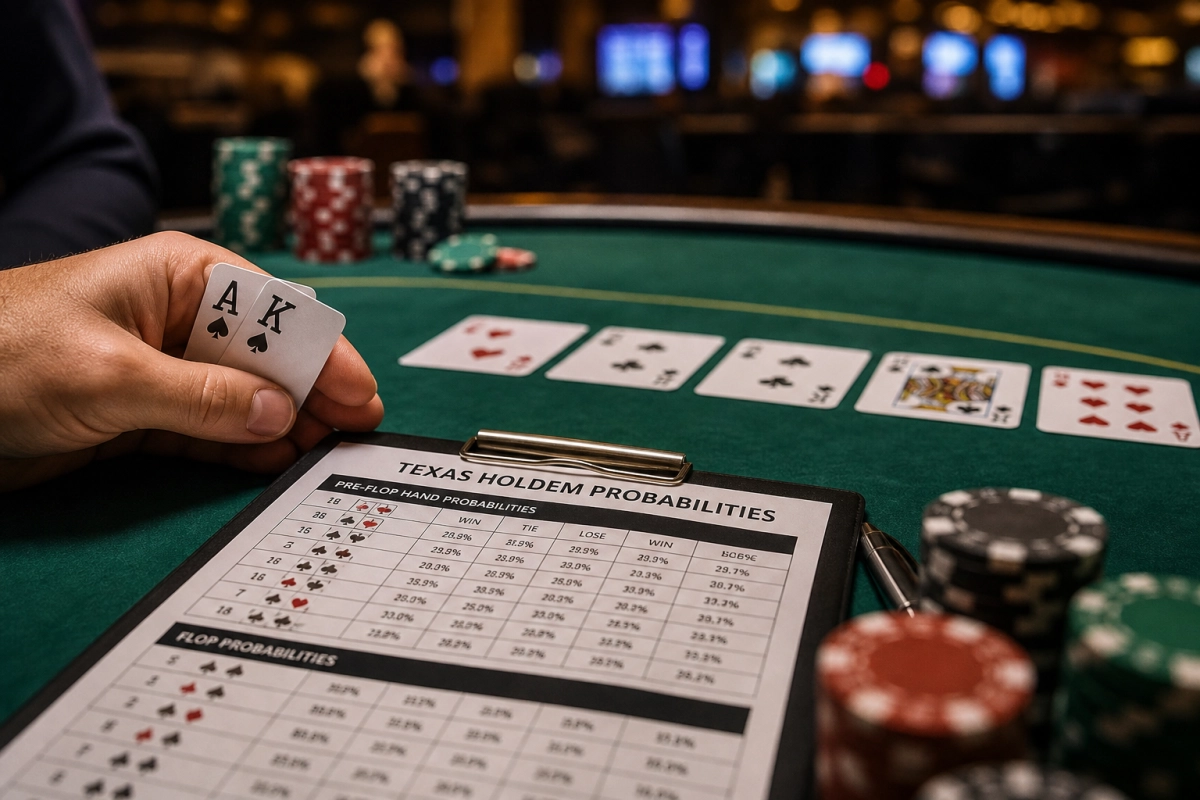
Why Numbers Matter More Than Instinct at the Poker Table
Most poker players rely on feel far longer than they should. Gut instinct has its place, but players who consistently make better decisions have internalized the core mathematics behind the game. Texas Hold’em statistics are not abstract academic material — they are practical tools that clarify whether a call is profitable, whether a hand is worth playing from a given position, and whether a draw justifies its price.
This guide translates raw probability data into actionable understanding. Rather than presenting numbers in isolation, each section connects figures to real situations — from preflop hand selection to postflop drawing decisions under pressure. Probability tables offer a rational framework for decision-making that reduces costly errors over time, even if they cannot eliminate variance entirely.
Starting Hand Equity: What Your Two Cards Are Actually Worth
Every hand begins with two hole cards carrying a measurable equity advantage or disadvantage before a single community card is dealt. Equity refers to a hand’s share of the pot based on its probability of winning at showdown. Understanding preflop equity helps players distinguish between hands worth investing in and hands that simply look appealing on the surface.
Pocket aces hold roughly 85% equity heads-up against a random hand. That figure drops to approximately 31% against eight opponents each holding random cards. This is not a reason to play aces cautiously — it illustrates why thinning the field preflop is strategically sound rather than merely aggressive.
The gap between premium and speculative hands becomes clearer when equity is compared directly. King-queen suited carries around 62% equity heads-up against a random hand — competitive, but far more vulnerable than it feels. Seven-two offsuit wins only around 32% of the time in the same scenario. The practical takeaway is not simply to avoid bad hands, but to understand the equity cost of playing them from poor positions or at unfavorable odds.
Suited connectors occupy an interesting middle ground. Hands like jack-ten suited derive much of their value not from raw preflop equity — typically 40–46% against a random hand — but from their ability to improve dramatically on certain board textures. Their implied value increases substantially in multiway pots where completing a flush or straight pays off handsomely.
How Equity Tables Translate Into Preflop Ranges
Equity figures become most useful when they inform range construction rather than individual hand decisions. Experienced players use preflop equity data to build ranges — collections of hands they will open, call, or three-bet from each position. A player in early position should play a tighter range weighted toward strong standalone equity. A player on the button can profitably include hands with lower raw equity but higher playability.
Playing ace-jack offsuit from under the gun carries a different risk profile than playing it from the cutoff — not because the cards change, but because positional disadvantage reduces the hand’s realized equity across the full hand.
Drawing Hand Completion Rates: Putting Outs to Work
Once the flop is dealt, the key question becomes: how often will this drawing hand complete, and is the pot offering enough to justify chasing it? The answer starts with counting outs and converting them into probability.
An out is any remaining card that completes a drawing hand. A player holding two hearts on a board showing two more hearts has nine outs. A player with an open-ended straight draw has eight outs. These figures are fixed regardless of bet sizing or opponent behavior, making them a reliable anchor when everything else feels uncertain.
The Rule of 2 and 4 makes conversion straightforward. With two cards to come, multiply outs by four for an approximate completion percentage by the river. With one card to come, multiply by two. A nine-out flush draw completes roughly 36% of the time by the river from the flop, and about 18% on the turn alone — accurate enough to drive sound decisions without complex arithmetic under pressure.
Common Drawing Scenarios and Their True Probabilities
- Flush draw (9 outs): approximately 35% to complete by the river from the flop, around 19% on the turn
- Open-ended straight draw (8 outs): approximately 32% by the river from the flop, around 17% on the turn
- Gutshot straight draw (4 outs): approximately 17% by the river from the flop, around 9% on the turn
- Two overcards to a paired board (6 outs): approximately 24% by the river from the flop, around 13% on the turn
- Combination flush and open-ended straight draw (15 outs): approximately 54% by the river from the flop, making it a statistical favorite
That last figure deserves attention. A player holding both a flush draw and an open-ended straight draw is actually a slight favorite to complete a strong hand by the river. This changes the decision framework entirely — rather than calling cautiously, this situation often justifies semi-bluffing with a raise to apply pressure while holding a hand that will frequently improve regardless.
Pot Odds: The Bridge Between Probability and Profitable Decisions
Knowing a flush draw completes around 19% of the time on the turn is useful only when measured against the price of continuing. Pot odds create the link between raw probability and the economic logic of a call.
Pot odds express the ratio between the current pot size and the cost of calling. If the pot contains $100 and an opponent bets $50, calling costs $50 to win $150 total — pot odds of 3-to-1. To find the break-even percentage, divide the call amount by the total pot after calling: 50 divided by 200 equals 25%. A call is mathematically profitable only if the hand wins more than 25% of the time. A flush draw completing 19% of the time on the turn does not meet that threshold.
This is a concrete, repeatable framework that removes ambiguity from decisions that might otherwise feel like guesswork. Players who skip this step and call based on the visual appeal of their draw are paying a premium for uncertainty without verifying the price is worth it.
Adjusting for Implied Odds When Pot Odds Fall Short
Implied odds capture additional money that can reasonably be won if a draw completes. A gutshot straight draw that fails the strict pot odds threshold on the flop might still be a profitable call if stacks are deep and the opponent is likely to pay off a large river bet when the straight gets there.
The discipline lies in being honest about how often that scenario materializes. Players consistently overestimate future extraction — opponents do not always cooperate, and completed straights and flushes are not always well-disguised. A realistic implied odds calculation asks: how much additional money would need to be won on future streets to make this call profitable, and is that amount genuinely extractable given the opponent’s tendencies? Answering that question with precision requires combining probability awareness with opponent-reading — two disciplines that reinforce each other when developed together.
Translating the Tables Into Decisions That Actually Hold Up
Probability tables earn their value only when they become second nature — when a player no longer consciously calculates but recognizes the shape of a situation and responds with calibrated confidence. That transition from studying numbers to internalizing them is the real work of poker development, and it happens through deliberate repetition rather than passive familiarity.
What the numbers cannot do is replace judgment. Texas Hold’em introduces variables no static table fully captures — the opponent who never folds, the board texture that disguises a completed draw, the stack-to-pot ratio that transforms a marginal call into an obvious one. Probability is the foundation, not the entire structure.
A few principles emerge consistently from working through these tables seriously:
- Hands that look strong often carry less equity than they feel like they do, particularly in multiway pots
- Drawing hands are more valuable in deep-stacked situations where implied odds are genuine, not imagined
- Pot odds failures are non-negotiable — no amount of optimism compensates for calling when the mathematics are clearly negative
- Position amplifies every equity advantage and softens every equity disadvantage
- The Rule of 2 and 4 introduces acceptable rounding errors; for high-stakes precision, exact probability tables are worth studying separately
Poker rewards the patient accumulation of small edges. Each decision that respects underlying probability, rather than overriding it with wishful thinking, represents a fractional gain that compounds meaningfully over thousands of hands. The players who build profitable long-term results are rarely the ones making dramatic hero calls — they are usually the ones who have quietly mastered the arithmetic most opponents never bother to learn.
Returning to these tables periodically, stress-testing them against hands played and decisions questioned, is one of the most efficient uses of time available to any serious poker player. The numbers do not shift. What changes is the depth of understanding brought to them — and that depth is where the real edge lives.