

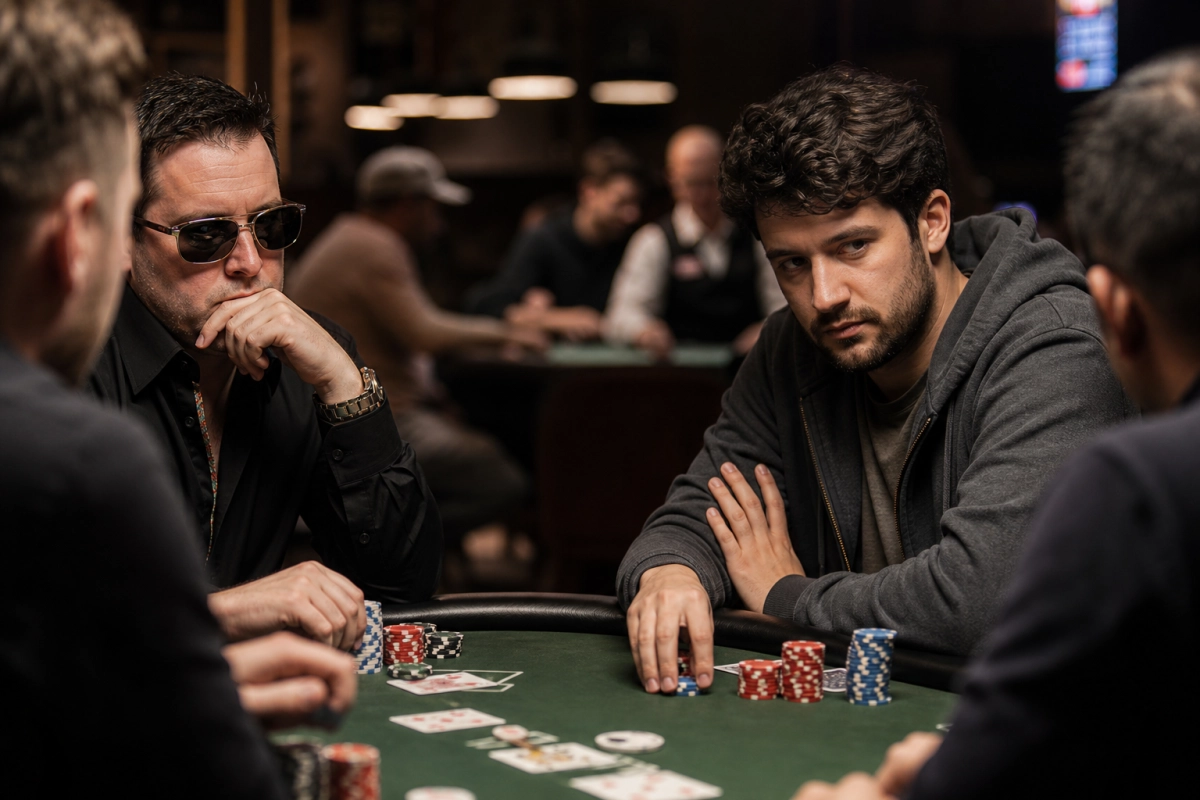
What Poker Tells Actually Are and Why They Matter
Every player at a poker table communicates something, whether they intend to or not. A slight pause before betting, a change in posture, an unusually quick call — these small signals are what poker players call tells. A tell is any observable behavior that may reveal information about the strength of a player’s hand or the confidence behind their decision. Understanding them is a core part of poker psychology, and reading them accurately can sharpen the way a player processes information at the table.
It is worth being clear from the outset: tells are not a reliable shortcut to winning. They are one layer of a much larger decision-making framework. A player who bets purely on gut reads, ignoring position, pot odds, and hand ranges, will consistently make costly mistakes. But a player who combines solid fundamentals with careful observation gains a meaningful informational edge, particularly in live games where physical behavior is visible and unfiltered.
What has evolved over time is the understanding of how tells work, how easily they can be faked or misread, and how differently they appear depending on whether the game is played live or online. Both settings offer tells — they simply look very different from each other.
Physical Tells in Live Poker: What to Observe and How to Interpret It
In a live setting, players are physically present, creating a rich environment for behavioral observation. The challenge is that most meaningful tells are subtle, context-dependent, and easy to misread without a baseline. Before drawing conclusions from a player’s behavior, establish what their normal state looks like — how they typically sit, how long they usually take to act, and how they handle their chips when the pot is not particularly interesting to them.
Once a baseline is established, deviations become more meaningful. A player who ordinarily makes quick decisions but suddenly freezes before calling a large bet may be genuinely uncertain — or they may be acting uncertain to disguise a strong hand. This ambiguity is precisely why tells must be interpreted with caution rather than treated as definitive signals.
Common Physical Patterns and What They May Suggest
Some of the most frequently observed physical tells involve breathing, eye contact, hand steadiness, and chip handling. A player whose breathing becomes visibly shallow or rapid after seeing their hole cards may be reacting to excitement over a strong hand or anxiety over a bluff in progress. Neither interpretation is certain, but the change itself is worth noting.
Chip handling often surfaces tells. Players who reach for their chips while an opponent is still deciding frequently telegraph a planned action — a timing tell that indicates genuine intent rather than strategy. Eye behavior is commonly discussed but remains one of the least reliable areas of observation. Some players stare directly at opponents when bluffing; others look away when most comfortable. Without history with a specific player, these signals carry limited weight.
Physical tells become progressively more useful the longer a player has observed the same opponent. A single hand provides very little. Thirty hands of observation, noting patterns across different situations and stack depths, builds a picture that is genuinely actionable. This is one reason experienced live players stay attentive even when not involved in a hand — watching others costs nothing and often returns valuable information later.
Behavioral Tells in Online Poker: Reading Patterns Without a Face
Online poker strips away everything physical. What remains are patterns embedded in timing, bet sizing, and the consistency or inconsistency of how a player acts across different situations. These behavioral tells are less intuitive than physical ones, but they are no less real — and in many ways more reliable, precisely because players tend to underestimate how much they reveal through them.
Timing is the most accessible tell available online. The variation between fast decisions and delayed ones carries genuine information. A player who calls instantly on the flop and then pauses noticeably on the turn may have connected with a draw or be reassessing the board. A snap-call on a large river bet often points toward a strong hand rather than a marginal one. Snap-folds, conversely, typically indicate a player who was never interested in the pot.
Bet sizing patterns are equally revealing. Many players develop unconscious tendencies — smaller bets when drawing, larger bets when they want the pot to end immediately, minimum raises as a semi-bluff tactic under pressure. Tracking these tendencies over a session, or using hand history tools many platforms provide, allows a player to identify and exploit them with precision.
The Role of Timing Tells in Identifying Strength and Uncertainty
Timing tells reward players who pay attention systematically rather than selectively. A few recurring patterns appear consistently enough to be worth internalizing:
- A long pause followed by a large bet often signals genuine strength — the player is calculating how much value to extract.
- A long pause followed by a minimum bet or check can indicate uncertainty or a marginal hand testing the waters cheaply.
- Unusually fast betting on consecutive streets may point to a player running through a pre-planned line rather than reacting to actual board texture.
- Auto-check or auto-fold patterns may signal someone distracted or playing too many tables to engage meaningfully with each hand.
None of these observations function as rules. A sophisticated opponent may deliberately vary timing to disguise tendencies, and some players simply act quickly on every hand regardless of strength. Context determines how much weight to assign any single observation.
The Limits of Tells and the Danger of Over-Reliance
There is a seductive quality to reading tells that can become a liability if unchecked. The feeling of having decoded an opponent is compelling — and also frequently wrong. Human behavior is inconsistent, context-sensitive, and shaped by factors entirely unrelated to poker: fatigue, distraction, external stress, even physical discomfort.
Experienced players also actively weaponize expected tell behavior against observant opponents. Mike Caro’s foundational work introduced the principle that players often behave opposite to their actual hand strength — acting strong when weak, and weak when strong. This remains a useful starting framework, but it breaks down against opponents who are aware of it and layer false tells on top of expected deception.
The most grounded approach treats tells not as conclusions but as data points that either support or complicate a reading already established through fundamental analysis. If pot odds, board texture, and opponent range strongly suggest a call, and a behavioral tell appears to confirm it, that reinforces a decision already sound. If a tell contradicts what the math suggests, the wiser response is to scrutinize the tell more carefully rather than abandon the logic of the hand.
Building Observation Into a Sustainable Decision-Making Process
The players who use tells most effectively are not the ones who trust them most — they are the ones who have learned precisely how much trust they deserve. That discipline develops fastest through deliberate practice. Simply playing more hands does not automatically sharpen observational skill. What sharpens it is active attention: watching opponents during hands you are not involved in, noting patterns without immediately acting on them, and revisiting reads after a session to evaluate whether they held up.
One practical approach is to treat observation as a skill running in parallel to the mechanical elements of the game. During a live session, use the first several hands as a data-collection phase — fold marginal spots, stay present, and build a profile on the players most likely to affect your results. Online, use whatever note-taking tools the platform provides. Even brief annotations — “fast-bets flops, slows on turns when drawing” — compound meaningfully over time with recurring opponents.
Tells, ultimately, are a language — imprecise, prone to misinterpretation, and dialected differently by every person at the table. Learning to read that language fluently means accepting its ambiguity rather than demanding clarity it cannot provide. A well-placed observation, folded into a decision already grounded in sound reasoning, is one of the quieter advantages available in poker. It rarely announces itself dramatically. It simply, over time, makes the right decision slightly more visible — and that, compounded across hundreds of hands, is more than enough.