

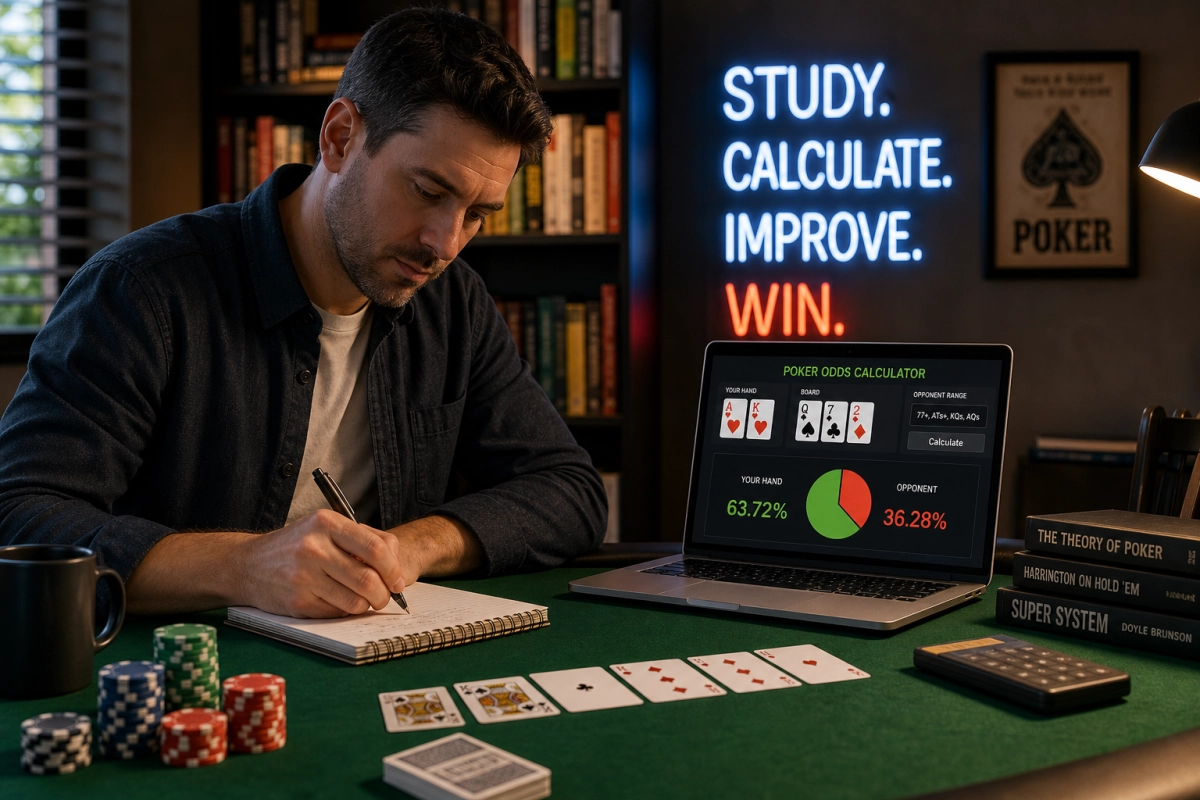
Why a Poker Odds Calculator Is More Than a Shortcut
Most players discover a poker odds calculator during a frustrating losing session. They plug in their hand, check the numbers, and feel reassured — or deflated — depending on what the output says. That reaction is understandable, but it reveals a missed opportunity. The real value of these tools is not in confirming a single decision after the fact. It is in building a mental framework that transfers directly to the table, where there is no calculator open and decisions happen in seconds.
A poker odds calculator takes the cards involved in a hand — your hole cards, your opponent’s range or specific holdings, and any community cards already dealt — and computes each player’s equity as a percentage. Equity is your statistical share of the pot based on how often your hand wins across all possible runouts. If the calculator shows 58% equity, your hand wins roughly 58 times in every 100 identical situations. That figure alone can reshape how a player thinks about calling, raising, or folding in comparable spots.
The distinction worth drawing early is between passive use and active learning. Passive use means checking results occasionally and moving on. Active learning means asking why the equity sits where it does, what board textures shift it dramatically, and how small changes in hand combinations create large swings in winning probability. Players who engage that way internalize patterns rather than recalling isolated facts.
Reading Calculator Output Across Different Streets
One of the most instructive exercises a player can do is run the same starting hand through a calculator across multiple board textures and observe how equity changes from preflop through the river. This reveals something classroom theory takes much longer to convey: equity is not fixed. It shifts with every card, sometimes dramatically.
Consider ace-king suited facing pocket tens before the flop. The calculator will show this matchup sitting close to even, with a slight edge to the tens. Run the same hands against a flop of ten-seven-two, and the picture changes sharply — the tens connect for a set and ace-king is drawing thin. Flip the flop to ace-king-four, and the positions reverse entirely. These shifts represent real decisions about pot size, bet sizing, and whether to continue.
Studying these transitions street by street trains a player to think in terms of ranges and board interaction rather than reacting purely to their own cards. Patterns become recognizable. Flush draws typically carry around 35% equity against a made hand on the flop. Open-ended straight draws sit in a similar range. Gutshots are weaker, closer to 16% with one card to come. A player who has run these scenarios repeatedly does not need the software at the table — those figures become instinctive reference points.
Translating Equity Into Practical Betting Decisions
Equity figures only become useful when connected to the actual bet being faced. If there is 100 in the pot and an opponent bets 50, a player needs to call 50 to win 150 total — requiring roughly 33% equity to break even over the long run. If the calculator has shown a similar draw carrying 35% equity, the call becomes mathematically sound: not guaranteed to win this hand, but correct as a repeated decision across many sessions.
Practicing this connection between equity output and pot odds is one of the most transferable habits a player can develop away from the table. The calculator provides the equity; the pot odds formula provides the threshold. Matching the two is the skill. Once that habit becomes second nature through repeated study, players find themselves instinctively estimating whether a call clears the mathematical threshold during live or online play — even without the exact figure available.
Using Hand Versus Range Analysis to Build Realistic Expectations
Most beginners run simulations as a head-to-head exercise — one specific hand against another. That approach has early value but quickly hits a ceiling. Real opponents arrive with a range of possibilities, and learning to use a calculator against ranges rather than individual holdings is where the tool starts producing genuinely strategic insights.
When a player reraises before the flop and gets called, the caller is not holding a single known hand. They might hold any pair from sevens upward, suited broadway cards, or strong suited connectors depending on their tendencies. Running a hand against that wider construction produces a far more accurate picture of actual equity. A hand that looks vulnerable against pocket aces might hold 52% equity against a reasonable calling range, which changes the calculus of the original decision entirely.
This shift teaches players to think about opponent construction deliberately. Instead of asking what the opponent has, the question becomes what hands make sense given the action, the position, and the history of the hand. Practicing this repeatedly builds the habit of range thinking, which eventually surfaces as a natural instinct during live play.
Spotting Equity Shifts That Signal Danger or Opportunity
One of the more nuanced lessons a calculator delivers involves recognizing when a lead is fragile versus robust. Running scenarios where a top-pair hand faces a flush draw illustrates this clearly. On a dry board, top pair might hold equity comfortably above 65%. Add two suited cards, and that margin compresses. Add a third on the turn, and the dynamic shifts again. These numbers map directly onto decisions about whether to bet for protection, how large that bet should be, and whether check-raising serves better than leading out.
The same logic applies to paired boards. Running calculator scenarios where a low pair appears often reveals that an opponent holding trips has devastating equity against most one-pair holdings. Recognizing quickly during actual play that a paired board compresses an overpair’s lead is exactly the kind of pattern recognition that emerges from deliberate study rather than passive use.
Applying Calculator Insights to Position and Aggression Decisions
Equity percentages do not exist in isolation from position. A hand holding 40% equity in position — with the ability to control pot size and observe the opponent before committing chips — plays very differently from the same 40% equity out of position, facing a bet with no information yet available.
Working through these scenarios helps players develop a clearer sense of realized equity — the portion of theoretical equity that actually converts into winnings given the constraints of position and stack depth. A draw with solid equity on the flop may realize less of that equity out of position because opponents can bet it off before the draw completes. The same draw in position has more paths to either completing profitably or taking down the pot with a well-timed float.
Understanding through repeated study that drawing hands realize equity better in position, or that marginal made hands face steeper challenges when forced to act first, shapes preflop decisions about which hands to play from which positions and informs in-hand choices about whether to pursue a pot or release it cleanly.
From Calculated Study to Instinctive Judgment at the Table
The distance between studying a poker odds calculator offline and making sharp decisions in real time is shorter than most players expect — but only if the study is done with intention. Running a few simulations after a bad beat and closing the software produces almost no lasting benefit. Returning to the tool repeatedly, with specific questions in mind and a willingness to sit with uncomfortable results, is what converts raw output into genuine table instinct.
The process works because poker decisions repeat. The same structural situations — a flush draw on a wet flop, an overpair facing aggression on a paired board, a marginal hand in position against a polarized bet — appear constantly across different opponents, stakes, and formats. A player who has examined those situations through a calculator dozens of times has already done the cognitive work before they arrive at the table.
What makes this preparation durable is that it builds understanding rather than scripts. A player who memorizes that flush draws have roughly 35% equity on the flop has a fact. A player who has run those scenarios against different board textures, watched that figure climb or fall based on overcards and backdoor outs, and connected it to specific bet sizes seen in real hands — that player has a framework. Frameworks hold up under pressure in ways that isolated facts rarely do.
The goal, ultimately, is to need the calculator less over time — not because precision stops mattering, but because the lessons it delivers have been absorbed deeply enough to resurface naturally. Every session of deliberate study compresses the gap between the number on the screen and the judgment formed mid-hand. That compression is the real return on the investment. The calculator is the training tool. The table is where the training pays out.