

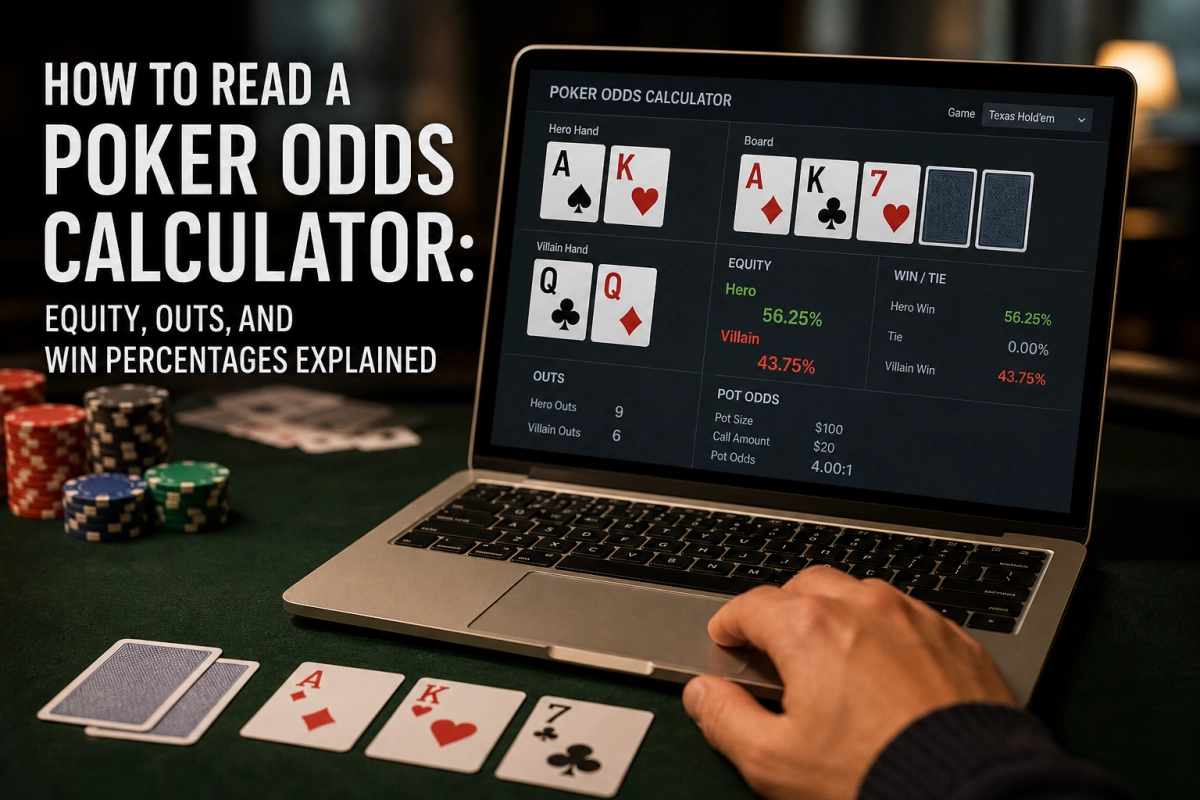
What a Poker Odds Calculator Is Actually Telling You
A poker odds calculator runs thousands of simulated hand matchups to show the mathematical probability of each hand winning, tying, or losing at any given point. Enter hole card combinations alongside board cards, and the calculator returns a precise breakdown based on all possible remaining card combinations. The numbers are accurate. The challenge is knowing what to do with them.
Many players glance at the equity percentage and treat it as a verdict. If their hand shows 65%, they feel safe. If it shows 30%, they feel beaten. But equity is not a scorecard for a single hand — it is a probability distribution across a large number of identical situations. Understanding that distinction is the first step toward using these tools as genuine decision-making aids rather than a source of false certainty.
Calculator output typically includes several distinct figures: equity percentage, number of outs, pot odds ratio, and a win/tie/loss breakdown. Each figure answers a different question and plays a different role in how a player should respond at the table.
Equity Percentages and What They Mean in Practice
Equity represents the share of the pot a hand would theoretically win if the remaining cards were dealt across every possible combination. If a player holds a flush draw on the flop and the calculator shows 35% equity against a made pair, that means roughly 35 out of every 100 times this scenario plays to showdown, the flush draw wins. The other 65 times, it does not.
This matters because poker decisions are made repeatedly over time. A player who consistently gets chips in with 35% equity is not making a catastrophic error in every case — context determines whether the decision is correct. If the pot is large enough relative to the cost of calling, a 35% equity hand can still be a profitable call. This is where equity intersects with pot odds, and where the calculator’s output becomes genuinely useful.
The win/tie/loss breakdown adds further clarity. A calculator might show 34% win, 2% tie, and 64% loss. The tie percentage matters in hands where split pots are possible — particularly in Omaha, where board-heavy hands and splits are far more common than in Texas Hold’em. Collapsing ties into either the win or loss column gives a distorted picture.
Counting Outs and Connecting Them to the Numbers on Screen
Outs are the individual cards remaining in the deck that would improve a hand to likely the best hand. A player holding two hearts with three hearts on the flop has nine remaining hearts — nine outs to complete the flush. The calculator reflects this by expressing the probability of hitting one of those outs by the turn, the river, or across both streets combined.
The rule of four and two offers a quick mental shortcut: multiply outs by four with two cards remaining, or by two with one card remaining, to estimate improvement probability. A nine-out flush draw gives approximately 36% with two cards to come, which aligns closely with a full calculator’s output. Building familiarity with this relationship makes it easier to apply the same logic at a live table or in a fast-paced online game.
Where players often go wrong is counting outs that are not clean. If several cards completing a straight would also give an opponent a flush, those outs carry less real value than the raw number suggests. A calculator can account for this when the opponent’s hand is known, but in a live game the number of effective outs is often lower than the theoretical count. Recognizing the difference between raw outs and effective outs is a meaningful step toward more honest hand assessment.
Pot Odds Ratios and the Decision Framework They Create
Pot odds represent the relationship between the size of the pot and the cost of a call. If the pot contains $90 and the opponent bets $10, a call costs $10 to win $100 — pot odds of roughly 9% of the total pot. If the hand has more than 9% equity, a call is mathematically justified over the long run.
The practical power of this framework is that it removes emotion from the equation. A player who feels dominated by a large bet can look at the pot odds ratio and recognize that bet size alone does not determine whether folding is correct — the ratio does. Large bets shrink pot odds, which is precisely why aggressive players use them to deny drawing hands the correct price to continue.
Some calculators also display implied odds, factoring in potential future bets that could be won if a drawing hand completes. Implied odds are less precise because they depend on opponent behavior that cannot be guaranteed, but they are worth considering when current pot odds fall slightly short of the required equity. The calculator flags the gap; the player fills it with table reads and situational judgment.
Reading the Win/Tie/Loss Breakdown as a Complete Picture
Most players fixate on the win column, but reading all three figures together reveals information that a single equity number obscures. Consider a Texas Hold’em scenario where the calculator shows 48% win, 6% tie, and 46% loss. The hands are essentially flipping, with a meaningful slice of outcomes ending in a split pot. Evaluated purely on win percentage, a player might feel they have a slight edge — but the tie percentage draws chips away in a way that affects expected value. In tournaments, where chip accumulation and survival carry different weight depending on stack sizes, the distribution across all three outcomes shapes decisions differently than in a cash game.
In Omaha, this breakdown becomes even more critical. Board-heavy runouts regularly produce tied hands, and the tie percentage in certain matchups can climb high enough to significantly affect how players value their holdings. A hand appearing dominant based on win percentage alone might in reality share substantial equity with the tie column, making the practical edge narrower than it first appears.
Translating Calculator Output Into Live Table Decisions
The gap between reading a calculator and applying its output at speed is where most players struggle. A poker odds calculator is a training tool as much as an analysis tool, and its long-term value comes from the pattern recognition it builds over repeated use rather than any ability to consult it in real time.
Players who study hand scenarios regularly start to internalize common equity benchmarks. They recognize that an open-ended straight draw is roughly a 2-to-1 underdog against a made hand on the flop. They know an overpair against two overcards is close to a coin flip. These benchmarks become a mental library that functions in place of the calculator when decisions must be made in seconds.
Specific habits help bridge the gap between study and application:
- Reviewing hand histories with a calculator after sessions to identify spots where intuition diverged from the math
- Running the same scenario type repeatedly — flush draw versus top pair, for example — until the equity range feels automatic
- Practicing pot odds calculations with simple numbers away from the table until the ratio becomes readable at a glance
- Noting when effective outs differ meaningfully from raw outs and adjusting equity estimates accordingly
The calculator does not make decisions. It produces numbers that only carry weight when a player understands what question each figure is answering. Equity says who is favored. Outs explain why. Pot odds determine whether the math supports continuing. The win/tie/loss breakdown shows the full spectrum of possible outcomes. Together, these figures form a coherent picture — but only for a player who has taken the time to understand each piece on its own terms.
The Math Is the Starting Point, Not the Destination
Every figure a poker odds calculator produces represents a precise answer to a precisely defined question. The limitation is that poker questions at a live table are rarely that clean. Stack depths, position, player tendencies, tournament pressure, and table dynamics all sit outside the calculator’s frame, and they matter enormously to whether the mathematically correct play is also the situationally correct one.
What the calculator provides is a reliable foundation. It strips away in-hand emotion and replaces it with a number verified across every possible remaining card combination. Players who bypass this foundation and rely purely on feel are working with a far less stable structure than they typically realize. The math does not guarantee outcomes — nothing in poker does — but it ensures decisions are made for defensible reasons rather than reactive ones.
Used well, a poker odds calculator reshapes how a player thinks about the game at a structural level. The equity mindset — evaluating situations as one instance within a recurring pattern rather than a singular high-stakes moment — is one of the most transferable shifts a developing player can make. Once that shift takes hold, the calculator becomes less of a crutch and more of a calibration instrument, useful for confirming instincts, correcting blind spots, and stress-testing the logic behind decisions that felt right but perhaps were not.
The numbers on screen are only as useful as the understanding behind them. Build that understanding systematically, apply it honestly, and the output of even a simple odds calculator becomes one of the sharpest edges available to a serious player.