


Make faster preflop decisions with a free starting hand chart
When you sit at a poker table, the first two cards you see set the tone for the entire hand. A concise, well-designed starting hand chart helps you translate those two cards into a clear action: fold, call, or raise. You don’t need to memorize dozens of complex ranges right away—what you need is a simple map that tells you the statistically best preflop plays for common situations.
This part introduces why a printable chart matters and how to interpret its core symbols so you can begin using it immediately at cash games or tournaments. Learning to rely on the chart initially frees up mental bandwidth for reads and postflop strategy while you gradually internalize the most profitable decisions.
Why a printable chart beats guessing at the table
- Consistency: You’ll avoid swings caused by on-the-spot mistakes. A chart gives you a repeatable framework for every hand.
- Speed: Preflop decisions are often time-sensitive. A printable chart lets you act quickly without overthinking.
- Learning scaffold: The chart acts as a training wheel—useful until your intuition matches the math behind it.
- Adaptability: Once you know the baseline chart, you can apply simple adjustments for position, stack sizes, and table dynamics.
How to read the free starting hand chart printable
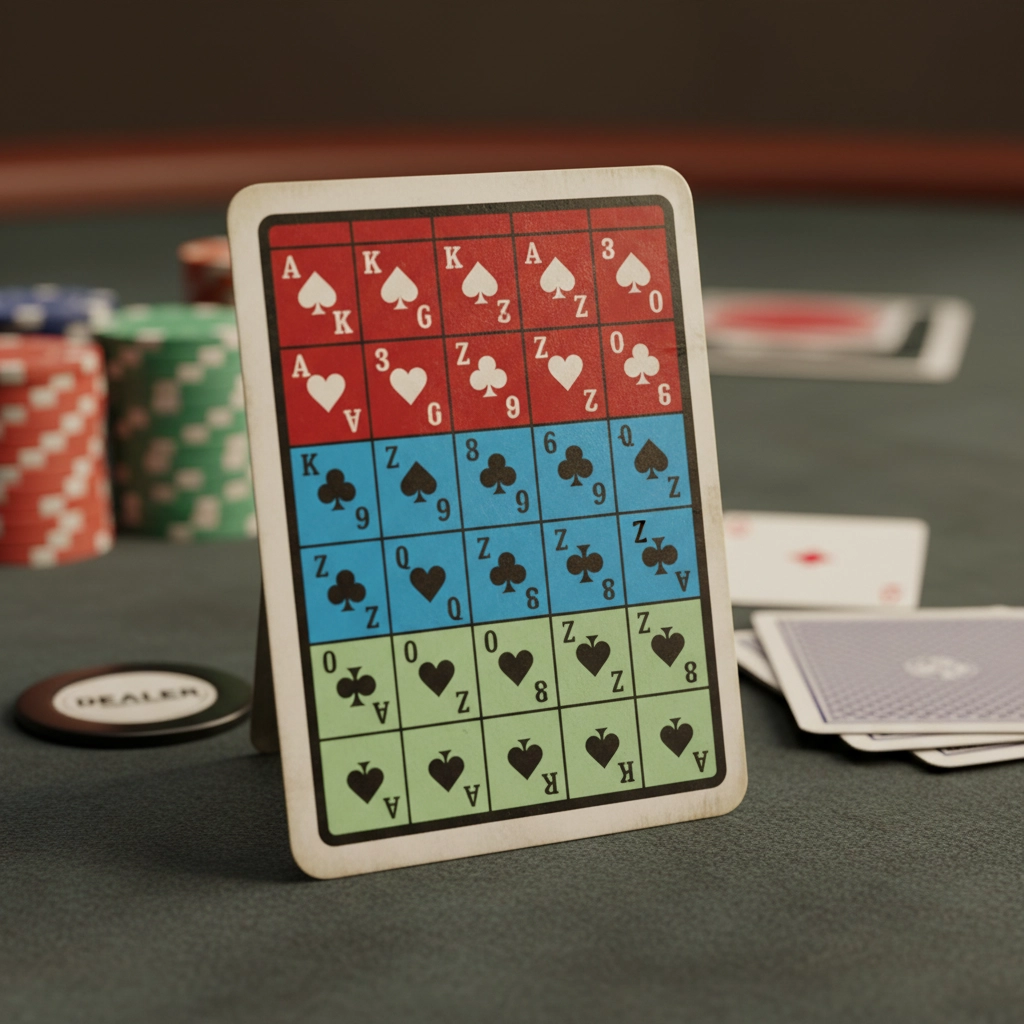
Most starting hand charts use a grid with ranks down the left and suits or hand types across the top, or a simplified color-coded table that groups hands by recommended action. Here’s how to parse the common elements so you won’t misread a play under pressure:
Core elements you’ll see on the chart
- Hand categories: Pairs (22–AA), suited connectors (like 76s), offsuited broadways (like KQo). Charts typically prioritize pairs and strong Broadway hands.
- Actions represented by colors or letters: Green (open/raise), yellow (call/limp), red (fold), blue (3-bet or defend). Learn this palette at a glance.
- Position tags: Some charts include separate columns for early, middle, and late position—or a simple note that the recommended action applies from a specific seat.
- Stack/ante notes: Look for any small-print adjustments when stacks are short or antes are in play; these can change marginal hands.
To start, focus on a chart version that shows recommendations for three broad situations: early position, late position, and facing a raise. That will cover most preflop scenarios and let you internalize a small set of rules instead of an overwhelming matrix.
In the next section you’ll get a clean, printable starting hand chart and step-by-step drills to memorize the best preflop plays quickly and reliably.

Printable baseline starting hand chart (text version you can copy & print)
Below is a simple, no-frills text chart that you can paste into a document and print. It gives a practical baseline for most cash games and 100bb tournament stacks. Use it as your default until you build reads and make adjustments.
Open/Raise — Early Position (EP)
– Raise: 88+, JJ+, AQs+, AKo
– Raise (selective): 99–TT, KQs, AJo (raise or fold depending on table looseness)
– Fold: everything else in EP
Open/Raise — Late Position (LP: cutoff/button)
– Raise: 22+, A2s+, ATo+, KTo+, QTo+, JTo
– Raise (steal/speculative): all suited broadways (KQs, QJs, JTs), suited connectors 76s+, suited one-gappers 86s+
– Raise (optional vs aggressive table): widen to include more offsuit broadways and suited low connectors
Facing a Single Open (100bb effective)
– 3-bet (value): JJ+, AKo
– 3-bet (value + polarized): AQs+, KQs (add if you want a polarized 3-bet range)
– 3-bet (bluff/semi-bluff): A5s-A2s, AJs (depending on opponent), KJs, occasional suited connectors (T9s, 98s)
– Call: 66–TT, AJo-AQo, KQo, KJs, QJs, suited connectors 76s-T9s
– Fold: most offsuit hands below broadway/off-suit connectors, weak suited gappers
Notes to print beneath the chart:
– These are baseline plays. Adjust for very short stacks (tighten) and very deep stacks (widen suited connectors and small pairs).
– Against very loose openers, widen calling and 3-bet bluff ranges. Against very tight openers, tighten and 3-bet more for value.
– Use position: in late position you can often raise hands you would fold in early position.
Memorization drills and practice routines to lock the chart into your head
Memorization is about repetition plus context. Use short, focused drills that replicate the time pressure and decision flow at the table.
1) Five-minute flashcard drill (daily)
– Create 50 index cards (physical or app): each shows a two-card hand (e.g., QTs, 77, AKo).
– Set a 5-second timer per card. Say the chart action aloud (raise/call/fold/3-bet).
– Track accuracy; repeat missed cards at the end of the session.
2) Deck drill (table simulation)
– Shuffle a deck, deal two cards to yourself, and decide the action within 6 seconds.
– Do 100 deals. This builds hand recognition speed and helps internalize suited vs offsuited and connectors.
3) Scenario sorting (strategy depth)
– Write 20 hands on paper. Sort them into three piles: Early-position open, Late-position open, Facing-open response.
– Explain to yourself (or a study partner) why each hand belongs where it does. That forces you to connect rules to reasoning.
4) Timed review + spaced repetition
– Review daily for 7 days, then every 3 days for three weeks, then weekly. Short, frequent reviews beat long cram sessions.
5) Table implementation plan
– Play short sessions using only the chart (no “intuition” deviations) for 2–4 sessions. Record hands where you deviated and why.
– After each session, mark which deviations were profitable (reads, stack-based) and which were mistakes.
Quick adjustment rules to practice
– If 150bb deep: add more suited connectors, small pairs, and more liberal 3-bet bluffs.
– Versus a very loose raiser: call wider and add more 3-bet bluffs. Versus a locked-down raiser: 3-bet more for value.
Use these drills consistently and you’ll move the chart from printed reference to automatic play, freeing you to focus on reads and postflop decisions.
Putting the chart into play
Print the chart, stick it in your case or phone notes, and use it as a practice scaffold: follow it strictly for a few short sessions, log deviations, and iterate. Treat the chart as a discipline tool that builds a reliable baseline — your ability to adjust (for reads, stack sizes, and table tendencies) becomes meaningful only after the baseline is automatic. If you want another free, ready-to-print version to compare against this one, download a printable chart and test which layout you find fastest to read under pressure.
Frequently Asked Questions
How often should I review the starting hand chart to retain it?
Short, frequent reviews work best: daily for the first week (5–10 minutes), then every 2–3 days for the next three weeks, and weekly thereafter. Use the five-minute flashcard and deck drills to keep recognition speed sharp under time pressure.
Do I need a different chart for cash games and tournaments?
Yes. Use the baseline chart for 100bb cash-game play or mid-stack tournaments. For short-stack tournaments (150bb) widen suited connectors and small pairs. Adjust for antes and payout structures in later tournament stages.
When is it appropriate to deviate from the chart at the table?
Deviate only for clear, documented reasons: opponent tendencies (very loose or very tight), stack-size changes, or strong reads that make a one-off play profitable. Record deviations and review them afterwards — profitable, repeatable deviations can be folded into your default ranges over time.