


Why the mental game matters as much as your cards
When you sit down at a poker table, whether live or online, you’re competing on more than just odds and position. Your emotions, attention, and decision-making under pressure determine how often you make +EV moves and how well you recover from inevitable setbacks. You can study ranges, pot odds, and GTO charts, but if a single bad beat causes you to play poorly for the next hour, all that study evaporates. Understanding poker psychology gives you tools to keep your A-game visible and make better decisions consistently.
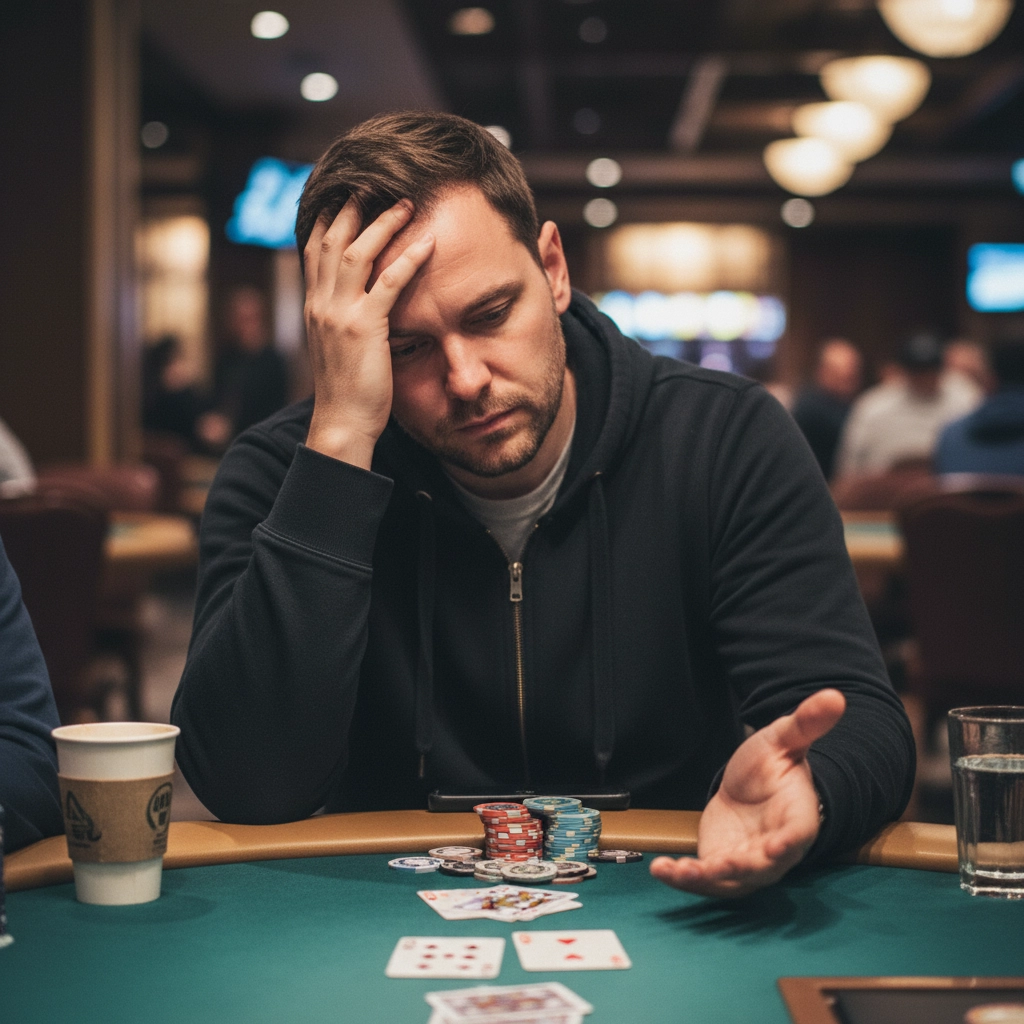
Bad beats are part of variance: even perfectly played hands lose sometimes. What separates winning players from break-even or losing players is not the avoidance of bad beats — it’s how you respond to them. You need techniques to manage immediate emotional reactions, frameworks to interpret losses rationally, and habits that prevent a single outcome from derailing an entire session or bankroll.
How bad beats affect your play and what to notice first
Before you can control reactions, you must recognize them. Bad beats don’t just hurt your bankroll; they change how you perceive risk and reward. Common early warning signs that a bad beat is influencing you include:
- Speeding up your decision-making or playing more hands than usual.
- Taking unnecessary risks or shoving when you’d normally fold.
- Overly defensive or reckless betting patterns (calling down too light or bluffing too often).
- Ruminating about past hands instead of focusing on the current spot.
- Physical signs like clenched jaw, shallow breathing, or tightened shoulders.
These are cues that tilt — an emotional state that impairs judgment — is setting in. Tilt is not a moral failing; it’s a predictable cognitive response to frustration or perceived injustice. Your goal is to spot it early and apply simple countermeasures so a bad beat becomes a single data point rather than the start of a destructive streak.
Immediate responses you can use at the table
When you feel a surge of frustration, using quick, practiced tactics prevents escalation. Try these immediate coping actions:
- Pause and breathe: Take three slow diaphragmatic breaths. Slowing your breathing reduces physiological arousal and gives your prefrontal cortex a chance to re-engage.
- Short timeout: Stand, stretch, or take a sip of water if you’re live. If online, look away from the screen for 15–30 seconds. Physical movement interrupts automatic responses.
- Label the emotion: Mentally name what you feel (“annoyed,” “angry,” “disappointed”). Labeling emotions reduces their intensity and improves control.
- Re-center on process goals: Remind yourself of process-focused objectives (e.g., “I’ll focus on making correct folds in position”) rather than outcome goals like “win this pot back.”
Reframing bad beats as useful feedback
Part of mastering the mental game is shifting how you interpret negative outcomes. Instead of seeing a bad beat as a personal affront, treat it as information. Ask these questions:
- Did I make a leak or a clear mistake that led to this result?
- If my play was sound, what does this hand illustrate about variance and risk management?
- Can I extract any strategic lessons — about bet sizing, timing, or opponent tendencies — that will improve future decisions?
When you consistently interrogate hands constructively, you convert losses into practice. This reduces frustration and builds a growth mindset: you view struggles as opportunities to refine skills rather than threats to your ego.
Practical session-level strategies to limit tilt and preserve long-term growth
Beyond immediate reactions, structure your sessions to reduce the chance that a bad beat will cascade into a losing night. Incorporate these routine practices:
- Set clear, measurable session goals focused on process (e.g., “avoid calling down outside of value range”) rather than short-term ROI.
- Define stop-loss rules: a fixed time or buy-in limit that, once reached, triggers a break. This prevents emotionally driven chasing.
- Log emotional state with hands: note when tilt influenced a decision so you can identify patterns during review.
- Practice mindfulness or short breathing exercises before play to lower baseline reactivity.
These structures help you treat poker as a skilled craft where controlled practice yields improvement. They also protect your bankroll and your confidence by keeping one unlucky hand from dictating your trajectory.
Now that you can recognize tilt, apply immediate coping tools, and build session habits that reduce emotional harm, the next section will show proven mental-training exercises and routines to convert these strategies into lasting resilience at the tables.
Daily mental-training routines to build long-term resilience
Like technical skills, mental toughness is developed through consistent, deliberate practice. Building short, repeatable routines makes resilience automatic so that when a bad beat happens, your default response is measured and constructive. Below are concrete daily exercises that take 10–30 minutes and compound quickly.
- Pre-session warm-up (10–15 minutes): Treat every session as a performance. Review a quick checklist: bankroll status, session goals (process-focused), recent leaks you’re working on, and one behavioral target (e.g., “no calling down marginal hands in position”). Then play 10–20 hands on a training site or review three hands from prior sessions to prime decision-making processes.
- Mindfulness micro-practice (5–10 minutes): Use a simple guided breathing or body-scan routine. Sit quietly, breathe for two minutes focusing on inhalation/exhalation, then do a 3–4 minute scan from head to toe noting tension and intentionally releasing it. This lowers baseline reactivity and improves attention during play.
- Visualization of process, not outcome (5–10 minutes): Run a short mental rehearsal where you vividly imagine handling a frustrating hand: notice the beat, label the emotion, take a breath, and return to your process goals. Doing this in low-stress conditions trains the same neural circuits you need live.
- Emotion and performance journaling (5–10 minutes): After sessions, jot three things: one strategic takeaway, one emotional trigger you noticed, and one corrective action to test next time. Over weeks you’ll see patterns and can create targeted experiments (e.g., “I tilt more after triple bad beats; add a 10-minute break after two losses > 50bb”).
Consistency matters more than duration. Even a short daily routine keeps your mental habits in shape. The aim is to make the calm, process-focused response your path of least resistance.
Stress inoculation: practicing under pressure and simulated adversity
Exposure reduces sensitivity. Stress inoculation techniques teach you to perform when emotionally taxed so an actual bad beat produces a measured, practiced response rather than reactive behavior. Use these controlled stress drills:
- Timed decision drills: Play practice hands with a self-imposed shorter decision timer to mimic the pressure of big pots. Alternate with normal-paced hands so you learn when faster play is appropriate and when to slow down.
- Forced adversity sessions: Deliberately assign yourself a “tilt tolerance” task: set a small buy-in and a rule like “if I lose two big pots in a row, I must pause and perform a 5-minute breathing routine.” This teaches recovery steps in a low-cost environment.
- Visualization of worst-case scenarios: Spend a session imagining a brutal run of variance and practice the full recovery routine: labeling emotions, physical reset, process re-centering, and logging. Mental rehearsal of failure reduces surprise and emotional escalation when it happens for real.
- Competitive pressure simulations: If you play live, organize small home games or stakes with friends where losing has minor but tangible consequences (e.g., winner gets a small prize). The presence of social evaluation and small stakes replicates tournament tension and boosts emotional control over time.
These exercises are not about making you immune to disappointment; they’re about reducing its behavioral impact. The more you practice recovery, the faster and cleaner your rebounds will be.

Review routines, accountability, and building a supportive environment
Longevity in poker requires honest review and outside perspective. Create systems that turn experience into improvement without inflating frustration or rationalizing poor play.
- Structured hand reviews: After a session, pick 3 hands: one clear mistake, one close decision, and one bad-beat hand. For each, note the decision tree you used, alternative lines, and whether emotion influenced your choice. Avoid rehashing every loss; prioritize hands that reveal actionable patterns.
- Emotional tagging and metrics: Maintain a simple log entry for each session with fields like session length, ROI, tilt level (1–5), triggers, and corrective actions. Over time you’ll spot correlations (e.g., fatigue increases tilt) and can make rule changes (adjust session length, shift game times).
- Accountability partners and coaching: Share your goals and session summaries with a coach or trusted poker peer. External feedback helps separate ego from evidence and provides perspective after brutal runs when your judgment skews toward short-term revenge play.
- Social and lifestyle supports: Sleep, nutrition, and regular exercise strongly affect emotional regulation. Treat these as part of your poker toolkit. Also, cultivate non-poker activities that refresh your identity—if poker is the sole source of self-worth, bad beats hit harder.
Creating reliable review structures and a support network turns variance into a controlled variable. You’ll reduce the emotional charge of setbacks and accelerate the conversion of losses into lasting skill gains.
Sustaining peak mental performance
Mastering the mental side of poker is an ongoing process, not a one-time fix. Treat your emotional skills like any other part of your game: design small experiments, measure what changes, and iterate. When you prioritize recovery strategies, structured reviews, and short daily practices, you create a durable edge that shows up as steadier decision-making and fewer costly emotional errors.
If you want practical tools to support mindfulness and attention training, explore reputable guided programs and exercises such as mindfulness resources to find short practices that fit into your routines. Commit to tiny, repeatable habits and let compounded improvements carry your game forward.
Frequently Asked Questions
How should I respond immediately after a bad beat to avoid tilting?
Pause for a tactical reset: label the emotion (e.g., “frustrated”), take 3–5 deep breaths, stand or stretch for 30–60 seconds, and refocus on a single process goal for the next hand (such as position discipline). Use a pre-planned short routine so the reaction is automatic rather than improvised.
How long until I notice benefits from daily mental-training routines?
Improvements vary, but most players notice better emotional control and clearer decision-making within 2–6 weeks of consistent short practices (10–30 minutes daily). The key is regularity and tracking—use brief journaling to confirm changes and adjust exercises if progress stalls.
When is it appropriate to seek coaching or outside help for tilt and mental game issues?
If tilt regularly causes bankroll damage, session-ending behavior, or chronic avoidance of higher-stakes play despite solid technical skills, it’s time to get outside help. A coach, sports psychologist, or experienced peer can provide accountability, identify hidden patterns, and introduce targeted strategies you may not discover on your own.