

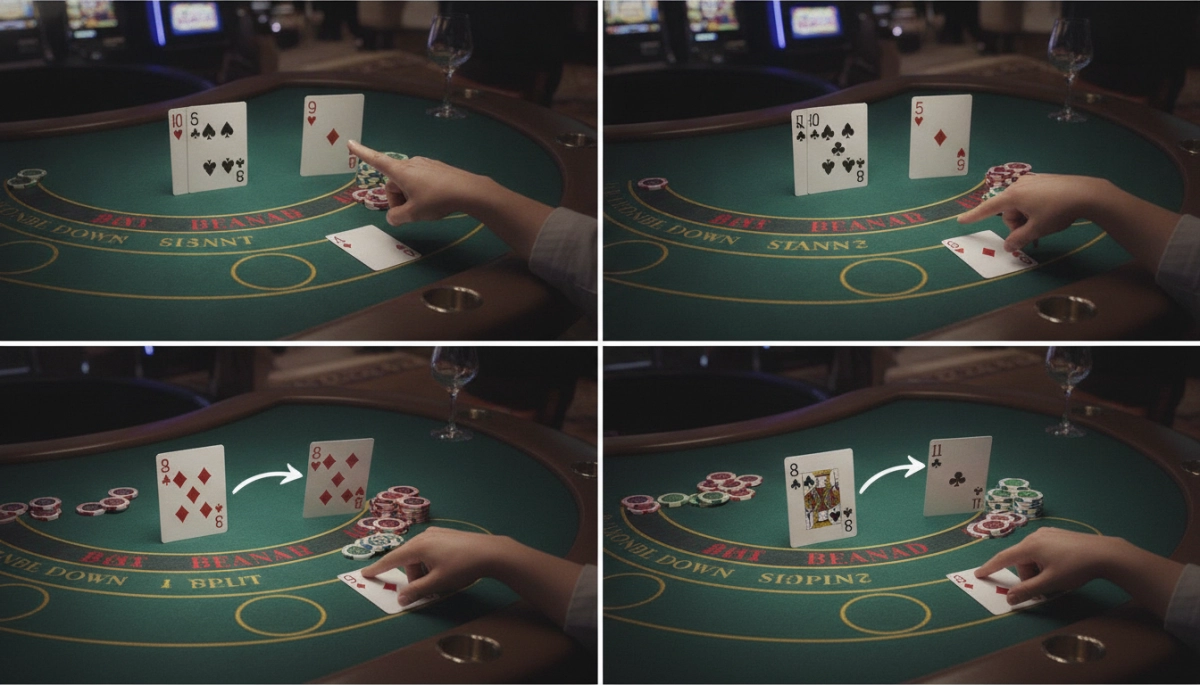
How understanding basic blackjack strategy shifts the odds in your favor
Blackjack is one of the few casino games where skillful decision-making measurably affects the outcome. When you learn and apply basic strategy, you reduce the house edge to its minimum by making mathematically optimal choices for every possible hand versus the dealer’s upcard. This doesn’t guarantee a win on every hand, but it maximizes your expected return over time and keeps variance under control.
Basic strategy is a set of simple rules derived from probability and simulation. It tells you, for example, when you should hit or stand, when splitting pairs increases expected value, and when doubling down is the strongest play. You don’t need to memorize every permutation immediately—start with the core concepts below and build toward using a full strategy chart at the table.
Recognizing the types of hands you’ll play and why they matter
Every decision in blackjack depends on two things: your hand composition and the dealer’s visible card (the upcard). You should quickly classify your hand as one of three types so you can apply the correct rules:
- Hard totals — Hands without an ace counted as 11 (or where the ace counts as 1). Example: 10–7 = hard 17. These hands are vulnerable because you’ll bust more easily when hitting.
- Soft totals — Hands that include an ace counted as 11, such as A-6 (soft 17). Soft hands are flexible: hitting can’t bust you immediately because the ace can revert to a value of 1.
- Pairs — Two cards of the same rank (8-8, 7-7, A-A). Pairs allow a split option that creates two new hands and can often turn a weak start into an advantage.
Distinguishing these quickly at the table makes your decisions consistent and fast, which is also important in live play.
Basic hit and stand rules you can use immediately
Use these core rules as your foundational play until you memorize more nuanced chart entries:
- If you have a hard total of 17 or higher, usually stand — the risk of busting outweighs potential improvement.
- Hard totals of 12–16 are situational: stand if the dealer shows 2–6 (dealer likely to bust), hit if the dealer shows 7–A (dealer likely to reach a stronger total).
- With soft totals, be more aggressive: hit a soft 17 or less; with soft 18, stand against dealer 2–8 but hit or double against 9–A in many single-deck rules.
- Ace and eight pairs (A-A and 8-8) are almost always split; avoid splitting tens or face cards because 20 is a strong hand.
These rules cover a large portion of common situations and will immediately improve your play. In the next section, you’ll learn the finer points of splitting and doubling, and how to use a full basic strategy chart to guide every decision at the table.
Splitting pairs: when to break and when to stand pat
Splitting lets you convert one weak or middling hand into two hands that can win independently. That potential comes with a risk — you’ll need extra chips and you may face tougher dealer upcards — so split only when the math favors it. Use these practical, table-ready rules as your baseline:
- Always split A-A and 8-8. Aces give you two chances at 21 and 8-8 turns a poor 16 into two hands with much better prospects.
- Never split 10s or face cards. A 20 is a powerful hand; splitting it usually reduces your expectation.
- Split 2-2 and 3-3 against dealer 2–7. Against weak upcards the dealer is likely to bust or finish low, so creating two hands improves expected value.
- Split 4-4 rarely; only vs dealer 5–6 in some rule sets. Treat a pair of 4s as a hard 8 to double rather than splitting in most games.
- Split 5-5? No — treat as a hard 10 and look to double. Splitting 5s is almost always wrong because a combined 10 is a strong doubling candidate.
- Split 6-6 vs dealer 2–6; split 7-7 vs 2–7. These breaks leverage dealer weakness and improve your chances to reach 17+ on each hand.
- Split 9-9 vs dealer 2–6 and 8–9, but stand vs 7, 10, A. Nine-pair is flexible: splitting gains when the dealer shows middling weakness, but standing is better against dealer tens and aces.
Quick memory tip: prioritize splitting Aces and eights always, never split tens, and use dealer upcard ranges (2–6 is generally “weak”) to decide the rest.
Doubling down: seizing the most profitable moments
Doubling down gives you one more card in exchange for doubling your wager — a powerful lever when your expected return is above even money. Basic strategy pinpoints the most profitable doubling spots so you don’t gamble chips on low-expectation plays.
- Hard totals: Double 11 against any dealer upcard (a near-automatic profit spot). Double 10 versus dealer 2–9 (avoid 10 vs 10/A) and double 9 against 3–6 when the dealer is likely to bust or end with a weak total.
- Soft totals: Because the ace reduces bust risk, you can be aggressive. Double A-2 or A-3 (soft 13–14) vs dealer 5–6; double A-4 or A-5 (soft 15–16) vs dealer 4–6; double A-6 (soft 17) vs 3–6; and double A-7 (soft 18) vs 3–6 when favorable. Against stronger upcards, adjust to hit or stand per the chart.
- Practical rule: If your two-card total is 9–11 and the dealer shows a weak upcard (usually 2–6), doubling is often correct. If confident, double more aggressively on soft hands per the ranges above.
Remember: doubling confines you to a single extra card, so only double when the probability of improving to a win outweighs the extra stake.
Using a basic strategy chart at the table and adapting to rule variations
A printed or memorized basic strategy chart is your roadmap for every hand. Read rows as your hand (hard, soft, or pair) and columns as the dealer’s upcard; the intersection tells you the mathematically optimal play. A few practical tips make charts usable in live play:
- Practice with online drills or flashcards until the most common situations (hard 12–16 vs 7–A, soft 17 decisions, splitting aces/eights) become instinctive.
- Check table rules: number of decks and whether the dealer hits or stands on soft 17 change some chart entries. For example, if the dealer hits on soft 17, you should be slightly more conservative in some doubles and splits.
- Use surrender if available: early/late surrender alters the math for hard 15 and 16 vs dealer 9–A and can be a valuable reduction in long-term loss.
With these splitting, doubling, and chart-use habits, you’ll cover nearly every decision at the table with confidence and math-backed precision. In Part 3 we’ll wrap up with practice drills, bankroll tips, and how to handle unusual table rules.
Practice drills, bankroll basics and handling table rules
Turn knowledge into consistent play with short, focused practice and sensible money management. Use these practical steps before and during live play:
- Practice daily with drills or an app: 10–15 minutes of hand-by-hand decision practice builds instant recall.
- Simulate the rules you’ll face at your casino (number of decks, dealer hits/stands on soft 17, double-after-split, surrender). Practice under those exact conditions.
- Keep a simple session log: hands played, key mistakes, and adjustments to track progress and reduce repeated errors.
- Bankroll rule of thumb: set a session bankroll equal to 20–50 times the table minimum and never chase losses. Establish win and loss limits and stick to them.
- Table etiquette and common-sense plays: use proper hand signals, play at a steady pace, decline insurance, and avoid emotional or impulsive deviations from basic strategy.
Keep practicing and play responsibly
Mastery of basic blackjack strategy comes from repetition, patience, and disciplined bankroll habits. Make the strategy chart your reference, practice the common scenarios until they’re automatic, and always confirm table rules before you sit. For reliable charts and deeper explanations you can use at-home, see basic strategy charts. Play smart, control your risk, and let consistent, math-based decisions shape your long-term results.