

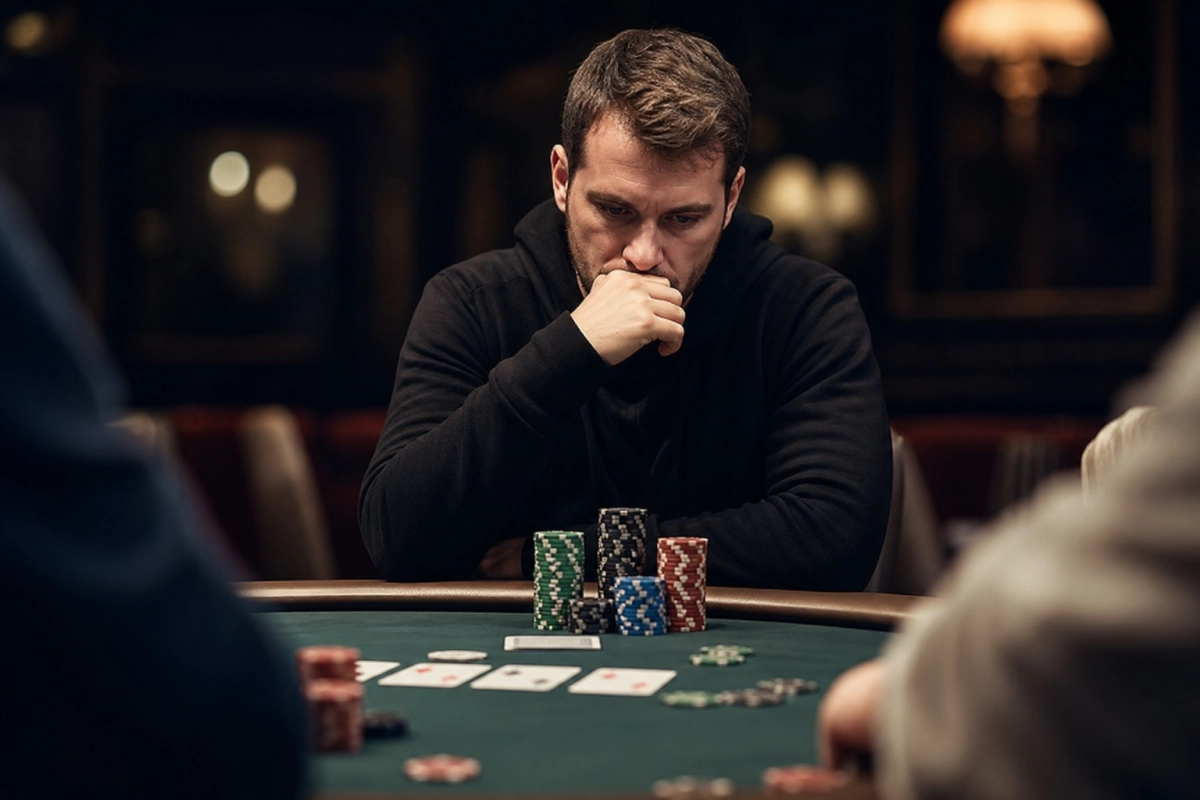
Why the Mental Game Matters as Much as the Cards
Most players who sit down at a poker table are thinking about hand rankings, betting rules, and game mechanics. Those things matter, but experienced players will tell you that the difference between breaking even and playing well over time often has less to do with which hands you hold and more to do with how clearly you think while holding them. Poker psychology — how emotions, perception, and mental discipline shape in-game decisions — sits at the core of what separates reactive players from deliberate ones.
Poker is unusual because the cards are only part of the equation. A player with a weaker hand can outperform one holding a stronger hand simply by managing the situation better. That depends on mental composure, accurate observation, and sound decision-making under pressure. None of those skills are fixed traits. They are developed through awareness and practice.
Emotional Discipline at the Table
Emotional discipline does not mean suppressing all feeling. It means preventing feelings from overriding judgment. Poker produces a steady stream of emotional triggers: the frustration of a bad beat, the rush of a well-timed bluff, the anxiety of a large pot building in front of you. Each moment creates a pull toward impulsive action. Emotional discipline is what allows a player to pause, reassess, and respond to the actual situation rather than to their emotional reaction to it.
Consider a simple example. A player raises preflop with pocket aces and watches an opponent hit two pair on the flop. The emotionally undisciplined response is to re-enter the next hand aggressively — calling wider, raising without clear justification, trying to recover the loss through force. That impulse is understandable but almost always compounds the damage. The correct response is to treat the next hand as an entirely separate event, because statistically, it is.
One practical approach is to focus on the decision-making process rather than the outcome of any single hand. A well-reasoned fold is a better decision than a reckless call that happens to win. Over time, consistently good decisions produce better results than outcome-driven thinking — though no approach guarantees profit, and variance is a permanent feature of the game.
Recognising the Signs of Emotional Drift
Before a player can correct emotional drift, they need to notice it happening. Early signs are often subtle: calling bets more quickly than usual, feeling impatient during other players’ turns, justifying loose plays with vague reasoning like “I had a feeling.” More visible signs include raising out of frustration rather than value, or folding too conservatively after a painful loss. Both overaggression and excessive caution can stem from emotional disruption.
The most effective immediate response is deceptively simple: slow down. Taking an extra few seconds before acting, even in situations that seem clear-cut, creates just enough space to ask whether the intended action is based on the hand’s merits or on how the session has felt so far. That small pause can prevent a cascade of poor decisions.
Reading Opponents Without Misreading Yourself
Observing opponents effectively is one of poker’s most discussed and most misunderstood skills. Popular culture dramatises it — the idea of catching a tell, some involuntary twitch that betrays a monster hand. In reality, opponent observation is far less cinematic and far more methodical. It is built on patterns gathered over many hands, not single moments of revelation.
The most reliable category of information is betting behaviour. How much does a player raise preflop with a strong hand versus when they are feeling out the table? Do they bet quickly when confident? Do they check-raise with draws or only with made hands? These tendencies rarely announce themselves in one hand. They emerge gradually, and an attentive player will accumulate a working profile of each opponent long before a critical pot develops.
Physical tells exist and can carry information in live play, but they carry a particular risk: confirmation bias. When a player decides they have spotted a tell, they become invested in it being correct and start filtering evidence to support the theory rather than test it. Acting on misread tells is frequently more damaging than ignoring physical cues and sticking to what betting patterns actually reveal.
What Opponents Reveal About Your Own Play
There is a subtler dimension to opponent observation that players often overlook. Watching how others respond to you — how they adjust aggression, when they fold against your bets — provides direct feedback about how your play is being perceived. If multiple opponents consistently call your raises with hands they would fold to a tighter player, that tells you something about your table image.
A player caught bluffing recently will find continuation bets carry less weight. A player who has shown down strong hands repeatedly may get less action when they need it most. Neither situation is permanent, but both require awareness. Adjusting to your perceived image is a layer of strategic thinking that only becomes accessible once you are genuinely watching how the table responds to you.
Decision-Making Under Pressure
Pressure in poker arrives in specific forms: a large bet with little time to decide, a tournament bubble approaching, or a session weighted with accumulated frustration. Each scenario creates cognitive load — the mental weight that makes clear thinking harder precisely when it needs to be clearest.
One well-documented tendency under pressure is the narrowing of focus. When stakes feel high, players zoom in on the most obvious feature — usually the cards they hold — and lose awareness of broader context. Pot odds slip from the calculation. The opponent’s previous tendencies fade into background noise. The decision gets made on incomplete information, not because that information was unavailable, but because pressure made it harder to process.
Experienced players counteract this by running a habitual sequence of questions whenever a meaningful decision arises: What does my opponent’s betting line suggest about their range? What is the pot offering me relative to the risk? Am I playing this hand or playing this session? That last question is particularly important. A decision contaminated by the emotional weight of earlier hands is rarely as clean as it needs to be.
The Role of Patience in High-Pressure Moments
Patience under pressure is not passive. It is an active discipline that requires resisting the pull toward resolution — toward doing something, anything, to break the tension of an uncertain situation. Many poor calls and premature folds happen not because the player misjudged the hand, but because they could not tolerate sitting with ambiguity long enough to think it through. Learning to remain comfortable in that suspended moment is one of the less glamorous but most genuinely useful skills a poker player can develop.
Building a Mental Game That Holds Up Over Time
The psychological skills that make a poker player formidable accumulate gradually, tested and refined each time pressure rises and the temptation to act on emotion becomes hardest to resist. Emotional discipline, opponent awareness, tilt recognition, and clear-headed decision-making are not separate modules — they reinforce one another, and weakness in any one creates cracks the others cannot always cover.
What separates players who develop these skills from those who plateau is usually a willingness to treat the mental side of the game with the same seriousness they give to technical strategy. Most players will spend hours studying hand ranges and position theory, and considerably less time examining why they made a specific call when they knew, on some level, it was not justified. That gap in self-examination is where avoidable losses quietly accumulate.
One practical step is reviewing sessions not just for strategic errors but for emotional ones. Which decisions came from genuine analysis, and which were responses to frustration, impatience, or the desire to recover something? Honest answers provide a clearer picture of where a player’s mental game actually stands versus where they assume it does.
Ultimately, the mental game is not a workaround for the difficulty of poker. It is a direct engagement with that difficulty — an acknowledgement that the game is hard precisely because it happens at the intersection of probability, human behaviour, and personal psychology. Players who understand that intersection clearly, and who keep working to navigate it honestly, are the ones who tend to hold up when it matters most. Not because the cards cooperate, but because their thinking does.