

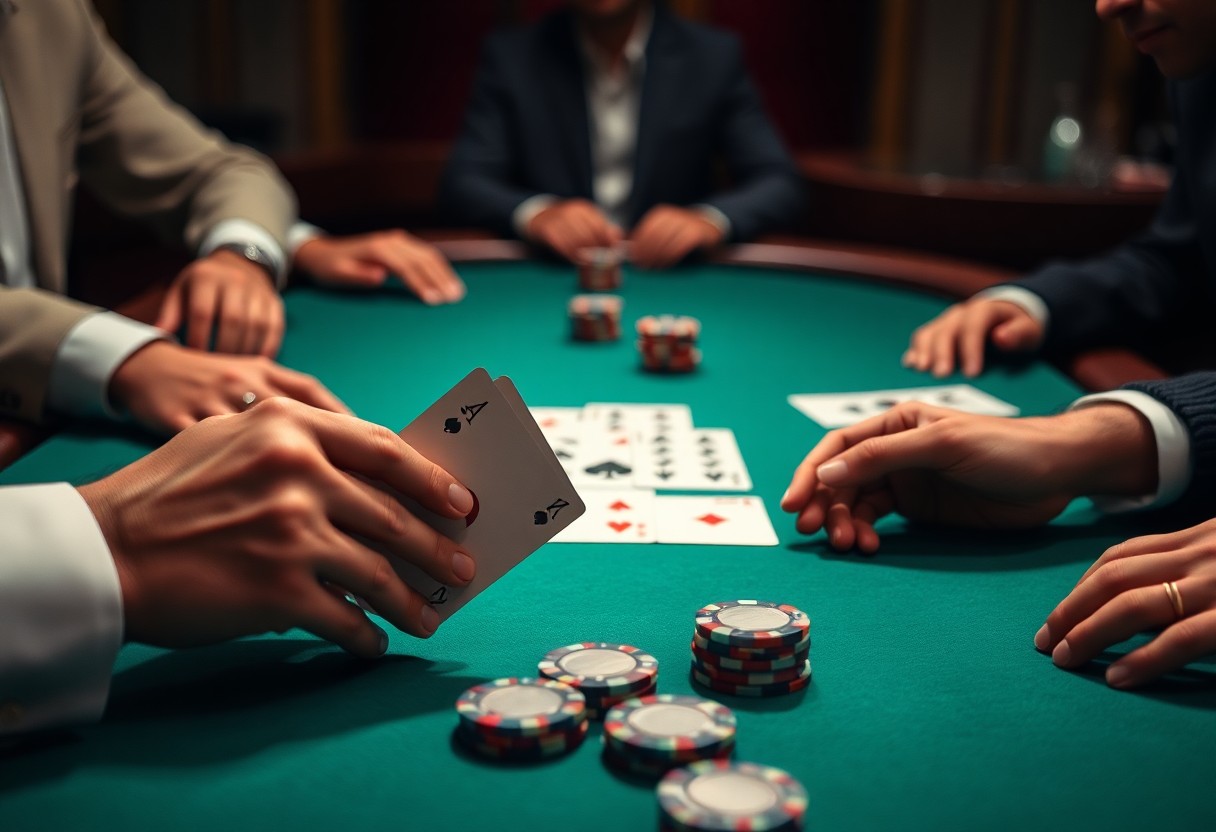
Most players underestimate how mental control and perception shape success at the table; this guide dissects why bluffs work and when they fail, teaching you to manipulate table image, exploit opponents’ tendencies, and deploy timing and sizing for maximum effect while managing the risk of costly misreads. Learn to read subtle cues, craft believable narratives, and balance aggression with discipline to consistently outsmart rivals.
Understanding the Types of Bluffing
- Pure bluff – no showdown outs, relies on fold equity
- Semi-bluff – betting with draws that can improve
- Continuation bluff – follow-up after preflop aggression
- Squeeze – re-raise to exploit multi-way weakness
- Double-barrel – apply turn pressure to force folds
| Pure bluff | All-in or large bet with no outs; depends solely on fold equity; effective when opponent folding frequency >70% for given bet size. |
| Semi-bluff | Bet with draws (e.g., 9 outs on a flush ≈35% to hit by river); combines fold equity and raw equity. |
| Continuation bluff | Bet after preflop raise; optimal on dry boards and versus single opponents; pro frequency ~50-65% depending on position. |
| Squeeze | Re-raise against a raiser plus callers; high fold equity when stacks are shallow and initial raise is weak. |
| Double-barrel | Fire turn after flop bluff; works when turn improves your story-beware fold equity often drops 20-30% versus sticky opponents. |
Pure Bluffing
Pure bluffs are high-risk plays where you hold no showdown outs; for example, shoving a missed backdoor on the river. Professional players size bets to force folds-bet-to-pot ratios matter: a bet of half the pot needs opponents to fold >67% to be +EV. Use pure bluffs sparingly versus calling stations and more often against tight, risk-averse opponents.
Semi-Bluffing
Semi-bluffs blend fold equity with drawing potential: an open-ended straight draw (8 outs ≈31.5% from flop to river) or a flush draw (9 outs ≈35%) lets you profit both by fold and by hitting. Against one opponent, semi-bluffs increase expected value markedly when pot odds make calling marginal for them and your perceived range is credible.
In practice, prioritize semi-bluffs when you have combined advantages: position, blocker cards, and a draw with >30% equity to improve. For example, with a 9-out flush draw in position facing a pot of $100, a $60 bet gives fold equity plus ~35% to hit, often converting questionable calls into profitable plays-track opponent tendencies and adjust frequency accordingly.
After calculating pot odds and fold equity, choose the bluff that maximizes expected value given stack depths and opponent tendencies.
Key Psychological Factors in Bluffing
Successful bluffs rest on layered psychological levers: table image, opponent tendencies, timing and consistency. Use frequency and patterns-professionals vary bluffs to about 5-15% of hands in late position-and avoid repeat lines that invite calls. Mix bet sizing and pauses to shape perception. Body language leaks and tilt vulnerability change fold equity. Recognizing when to bluff and when to fold separates winners.
- Table image
- Timing
- Bet sizing
- Body language
- Tilt
Reading Your Opponents
Scan for baseline behaviors: a habitual 2-4 second pause before betting often signals calculation, while instantaneous bets can indicate pre-decided plays. Watch for changes-if a caller suddenly raises 30% larger than usual, that’s a range-shift signal; if a quiet player begins sustained eye contact, expect aggression. Combine timing, sizing and recent history to assign a realistic fold probability to each opponent.
Emotional Control
Maintain neutral facial expression and steady breathing; players who reset within 10-15 seconds after a bad beat avoid cascade errors. Manage bet sizes to limit stress-keeping sessions to 1-2% of bankroll lowers impulse play. Emotional control preserves your ability to execute layered, deceptive strategies across long sessions.
Use concrete tools: take a 60-120 second break after big swings, practice box-breathing (4-4-4-4) to reset, and log sessions to detect tilt patterns-players who review 50+ hands weekly spot negative cycles faster. Set stop-loss rules (e.g., end a session after losing 3 buy-ins) and adopt deliberate routines to convert emotional volatility into controlled, repeatable decision-making.
Step-by-Step Guide to Bluffing Effectively
Break each bluff into discrete decisions: assess position, opponent tendencies, pot geometry and a believable betting story. Use metrics like stack-to-pot ratio (SPR) and observed fold frequency-for instance, with SPR ≤4 and a passive caller, a larger shove gains fold equity. Prioritize spots where you hold blockers, can polarize the pot, and size bets to threaten meaningful folds (river bets often land in the 50-70% pot range).
| Step | What to do (details / examples) |
|---|---|
| 1. Assess | Check position, SPR, table image and opponent type (e.g., VPIP>30 = loose). Note fold-to-bet rates; >60% suggests higher bluff frequency. |
| 2. Construct the story | Plan a coherent multi-street line using blockers and sizing consistent with the hand you represent (flop 30-50%, river 50-70%). |
| 3. Execute | Target single opponents, avoid multiway pots, and vary timing-use checks, delayed bets or instant c-bets to sell the narrative. |
| 4. Review | Track results over sample sizes (e.g., 500-1,000 hands), adjust frequencies, and note which opponents are sticky callers vs. fold-prone. |
Analyzing the Game Situation
Segment opponents quickly: tag players often fold to river aggression while loose-passive players call more. Use concrete reads-VPIP/PFR and recent showdowns-to estimate fold equity, and factor in table makeup: multiway pots cut bluff success dramatically, while heads-up pots increase it. Also weigh stack depths: bluffs against stacks under 20bb become less effective; stacks above 40bb allow deeper, multi-street storytelling.
Choosing the Right Moment to Bluff
Exploit windows where board texture and your range align-late position on a missed draw, or when a single opponent checks to you on the river. Favor spots with clear blockers to premium hands and when the opponent faces awkward pot odds. Practical bet sizing on the river (typically 50-70% pot) applies enough pressure while staying consistent with the hand you’re representing.
Apply this sample: on 9♦-7♦-2♠-5♣-K♣ holding A♣9♣ (blocking clubs), c-bet flop ~40% to represent a made hand, check the turn to control the pot, then fire ~65% on the river to polarize your range; against one opponent this line converts many marginal hands into folds. Measure performance over several hundred similar spots to fine-tune timing and frequency.
Tips for Outsmarting Your Opponents
Mix frequencies and cues: aim for roughly 30% bluff frequency on later streets in balanced spots, deploy semi-bluff when you have >30% equity, and adjust versus players who fold >50% to aggression. Use varied bet sizing-small bets for probing, 60-80% pot to exert pressure-and monitor timing patterns. Target opponents with predictable table image and exploit positional advantage to raise fold equity.
- Vary timing to mask intentions; don’t camp at a fixed pace.
- Use polarized ranges: combine nut-value bets with balanced bluffs.
- Exploit opponents who call too much-value bet 40-60% more often.
- Adjust to player types: isolate loose-passive with larger bluffs.
- Track recent hands: a player who folded thrice to river bluffs is a prime target.
Perceiving micro-adjustments-like a 0.5-3s timing shift or sudden tightening of eyes-lets you convert reads into profitable bets quickly.
Body Language and Tells
Watch for consistent patterns: a player who pulls chips forward before betting often shows strength, while repeated hand-to-face gestures can indicate discomfort when bluffing. Timing is telling-snap calls usually signal weakness or pot control, think-time >3s can mean either a strong decision or a constructed bluff depending on history. Live reads matter: baseline a player over 20-30 hands to distinguish natural ticks from deliberate deception. Use tells to corroborate, not to decide alone.
Creating a Compelling Story
Construct a coherent line across streets: if you c-bet the flop, follow with a logically consistent turn action and a river size that matches the hand you represent-use 60-80% pot to signify strength or 30-50% to probe. Blend value and bluffs so your range looks credible; players expecting a bluff frequency near equilibrium (~33%) will fold incorrectly if your narrative is tight and consistent. Strong bet sizing discipline sells the lie.
Develop examples: suppose you opened pot, c-bet flop 50% on K‑8‑3, check‑turned a blank, then lead 70% on the river after opponent checks-this sequence represents a turned king or slow-played set and forces folds from many medium-strength hands. Alternate this with occasional small river bluffs to keep opponents from narrowing your range; maintaining a 2:1 value-to-bluff ratio in visible spots helps preserve future fold equity and reinforces your table image.
Pros and Cons of Bluffing in Poker
Balancing deception and discipline defines effective bluffing: it can convert marginal situations into immediate wins but also generate big losses when misapplied. For example, betting $50 into a $100 pot requires opponents to fold >33.3% to be +EV, so sizing and opponent tendencies matter. Combine that math with table image and position to tilt outcomes; semi-bluffs with redraws reduce downside while pure bluffs demand superior reads and timing.
| Pros | Cons |
|---|---|
| Win pots without showdown by forcing folds when equity is low | Chip losses when called-can swing stack sizes quickly |
| Exploit tight opponents who fold too often | Become predictable if used too frequently |
| Build a fearsome table image to extract value later | Image can flip, inviting more calls and isolation |
| Semi-bluffs add equity with draws, improving expected value | Pure bluffs have zero showdown outs and higher variance |
| Force opponents into difficult decisions, inducing mistakes | Creates informational leaks about your range if caught |
| Useful in position to control pot size and narrative | Out-of-position bluffs are costlier and easier to exploit |
| Can shorten tournaments by pressuring medium stacks | ICM risk: late-stage bluffs can irreversibly damage equity |
Advantages of Bluffing
When timed correctly, a bluff turns fold equity into immediate profit; a $50 bet into $100 that folds opponents yields a direct $100 gain, so making opponents fold more than 33.3% is profitable. Additionally, combining bluffs with value bets widens your perceived range, letting you extract larger pots later. Using position and selective frequency, especially with semi-bluffs that have backdoor outs, increases long-term chip EV while reducing variance.
Risks Involved
Bluffing exposes you to being called and losing the stake; using the $50 into $100 example, if villains fold less than 33.3% your EV goes negative-if they fold 30% you lose money over time. Frequent bluffing against calling stations or aggressive players converts theoretical edges into real losses, and misjudged sizes amplify the cost of being caught.
More broadly, unchecked bluffing creates patterns opponents exploit: they adjust calling ranges, target you with isolation, and leak information about your hand selection. Tournament contexts add ICM pressure-with 20 big blinds, shove bluffs and fold equity calculations differ drastically-while cash games demand long-term balance. Maintain mixed frequencies, vary sizing, and track opponent reaction rates to minimize exploitation and preserve the long-term benefits of deception.
To wrap up
As a reminder, mastering bluffing hinges on reading opponents, managing your table image, and choosing moments that align with your range and bet sizing. Controlled aggression, emotional discipline, and attention to timing make bluffs effective; equally important is adapting to tendencies and minimizing predictability so your deceptions become a sustainable weapon rather than a reckless gamble.
FAQ
Q: When is bluffing most effective and how often should I attempt it?
A: Successful bluffs rely on position, opponent type, pot size, board texture and stack depths. Bluff more from late position and into single opponents who show tight calling tendencies; avoid multiway pots. Use semi-bluffs when you have equity (draws) so you can win either by fold or by making your hand. Size bets to tell a consistent story-larger bets can represent strong hands but cost more fold equity; smaller bluffs work when you expect weak calls. Adjust frequency by game format: tournaments with antes and bubble dynamics allow more pressure plays, while deep-stack cash games require more selective, higher-fold-equity bluffs. Track results and scale back if opponents start calling more often.
Q: What signals should I watch for to tell whether an opponent will fold or call?
A: Combine timing and behavioral patterns with betting history. Quick, mechanical calls often indicate weakness or a fixed calling range; long tanking before a bet can signal difficulty folding but sometimes deliberate deception. Watch bet sizing consistency-players who suddenly change sizes may be turning a hand or attempting a scare. Physical tells (posture shifts, breathing, eye contact) and verbal cues exist live; online, focus on timing, re-raise frequency, and showdown tendencies. Use past showdowns and HUD stats (if allowed) to build profiles. Treat single instances as data points, not proof; validate patterns over multiple hands before exploiting them.
Q: How do I balance bluffing so opponents don’t exploit me, and how do I recover when a bluff fails?
A: Blend bluffs with credible value bets and adopt a mix of polarized and merged lines so your ranges remain hard to read. Use blockers and hand selection to increase bluff credibility-hands that block strong opponent combos make better bluffs. Against observant players, shift toward more value-heavy lines or semi-bluffs that retain showdown equity. If a bluff is called, accept the loss without tilt, review your line for sizing or range mistakes, and note the opponent’s reaction for future adjustments. Over the long run, track EV of bluffs versus pure value lines and adjust based on opponent tendencies and game conditions rather than single outcomes.