

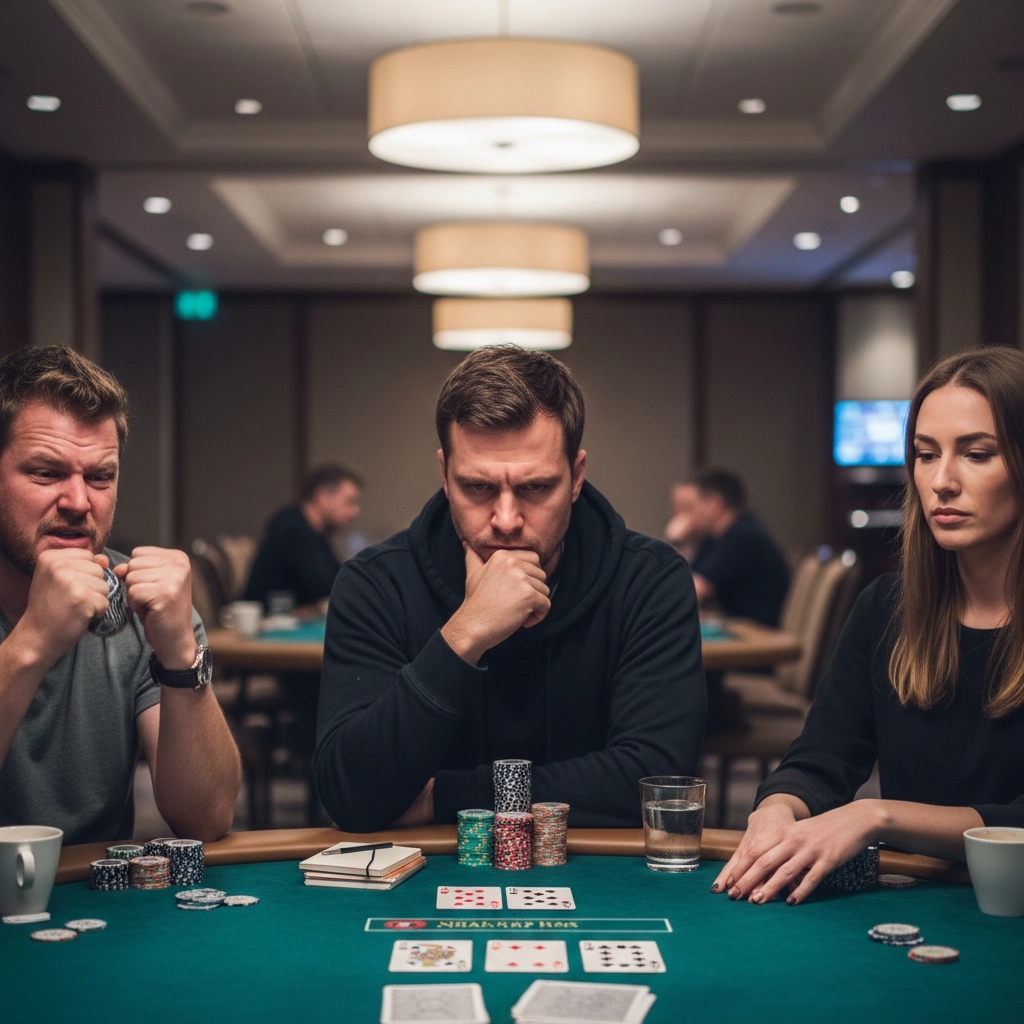
Why your mental game matters more than your hand
You can learn odds, ranges, and exploits, but if your head isn’t in the right place you won’t apply those skills consistently. Your mental game — the combination of focus, emotional control, and resilience after setbacks — determines whether you convert theoretical edge into long-term profit. When you’re distracted, reactive, or nursing a recent bad beat, small mistakes compound: you call down when you should fold, bluff ineffectively, or miss tells and betting patterns.
Think of poker as a decision-making sport played under uncertainty and social pressure. Each decision you make requires attention, memory of recent actions, and correct emotional calibration. The table environment amplifies stress: bright lights, music, time pressure, opponent behavior, and the natural highs and lows of wins and losses. Learning to manage those inputs is as important as knowing when to raise.
Sharpening your focus: habits and drills that help you see clearly
Focus is the foundation of every good session. When you can concentrate on the right information — stack sizes, bet sizing, recent hands, player tendencies — you reduce costly errors. You don’t need perfect concentration at all times, but you do need reliable ways to get back into a clear, analytical state when distractions occur.
Practical routines to improve table focus
- Pre-session checklist: Set intention for the session (targets like “play 1.5bb/100 hands” or “focus on poker fundamentals”), check physical needs (sleep, hydration), and decide on a stop-loss or time limit.
- Minimize distractions: Turn off unnecessary notifications, limit multi-tabling to a level you can comfortably observe, and create a consistent playing environment.
- Micro-breaks: Use 30–60 second breaks between orbits to reset your attention. Stand, breathe, and briefly review recent hands or adjust your plan.
- Focus drills: Practice concentration off-table with short exercises — 10-minute timed focus blocks, attention apps, or memory tasks — to extend your effective play window.
- Use procedural thinking: Adopt checklists for common spots (e.g., preflop open, 3-bet response, continuation bet sizing) so your cognitive load is reduced and you react to key variables.
By turning focus into a disciplined habit, you’ll be less likely to miss patterns or let emotions drive your play. The goal is not to be emotionless but to ensure emotions inform strategy instead of dictating it.
Recognize and control tilt before it costs you
Tilt is the poker player’s shorthand for emotional states that impair judgement. It often follows bad beats but can also be triggered by fatigue, table chatter, or a string of small losses. You will experience tilt; the skill is detecting it early and applying reliable interventions so it doesn’t become a losing streak.
Common signs you’re entering tilt and immediate actions
- Physiological cues: Faster heartbeat, shallow breathing, clenched jaw, or muscle tension — pause and take three deep breaths.
- Cognitive changes: Narrowed attention, exaggerated focus on a recent loss, or “get it back” thinking — force a short break or step away for a few minutes.
- Behavioral shifts: Larger-than-usual bets, reckless bluffs, or abandoning your strategy — revert to a simple, conservative plan or stop-play until you reset.
Concrete tools to manage tilt include timed cooling-off periods, predetermined stop-loss limits, and grounding techniques (breathing, counting back from 100, or physical movement). You can also create a behavioral rule: if you lose X buy-ins in a session or feel Y level of anger, you close the session and log the hand history later for analysis rather than continuing emotionally.
Emotional management also benefits from post-session reflection: record triggers, note patterns, and design preemptive strategies. Over time you’ll reduce the frequency and severity of tilt episodes by combining awareness with simple, repeatable responses.
Having established why focus matters and how to spot and interrupt tilt, the next section will show how to recover from bad beats, reframe setbacks, and build long-term mental resilience so you stay profitable through variance.

Recovering from a bad beat: immediate steps and after-session rituals
Bad beats are inevitable; how you respond to one determines whether it becomes a flame that burns your session or a single ember you learn from. The goal is to stop the emotional momentum immediately, then convert the experience into useful information without replaying it in your head for hours.
Immediate steps at the table
– Pause and breathe: As soon as you feel the anger or frustration spike, take 30 seconds away from the table (or just sit back, close your eyes, and do three slow diaphragmatic breaths). Slowing your physiology calms impulsive reactions.
– Create a short script: Have a neutral sentence ready to say out loud (or to yourself) like, “Okay — misfortune, move on.” A brief verbal cue interrupts rumination and anchors you back to process.
– Recenter with procedure: Run a one-line checklist for the next orbit — e.g., “Tighten preflop, avoid big bluffs for 15 minutes, note villain type.” This shifts cognitive load from emotions to mechanics.
– Avoid immediate revenge plays: If you feel compelled to “get it back,” fold marginal hands and stick to your bankroll rules. That urge is the key sign you’re still emotionally contaminated.
After-session rituals to process and learn
– Log the hand quickly and objectively: Record the key facts — position, stack sizes, ranges, line chosen, and a one-sentence rationale for the play. Don’t write a narrative of rage; focus on decisions.
– Ask three diagnostic questions: (1) Was the decision +EV given information at the time? (2) What could I reasonably have done differently? (3) What did the opponent’s actions reveal? These prevent counterfactual “I should have won” thinking.
– Cool-off buffer before review: Wait until you’re calm — at least a few hours — before analyzing the hand seriously. Reviewing while emotional guarantees bias.
– Normalize variance numerically: Keep a simple tracker of ROI and showdown rate over time, or consult software to show expected distribution. Seeing the statistical context reduces the personal sting of a single outcome.
Treat a bad beat as a data point, not a verdict. That stance allows you to maintain clarity and keep losing sessions from snowballing into poor decisions.
Build long-term resilience: processes, habits, and training that reduce emotional volatility
Resilience isn’t about never feeling bad; it’s about creating systems that limit how much emotional swings affect your decision-making. Build habits that reinforce the process rather than the result.
Process-focused routines
– Daily micro-practice: Spend 10–20 minutes on mental training — focused breathing, visualization of good decisions under pressure, or a short mindfulness exercise. These exercises strengthen attentional control over weeks.
– Session structure: Define clear inputs (hands played, focus on a specific skill) and outputs (stop-loss, session time) before you start. When outcomes are tied to inputs, you evaluate performance by what you controlled, not by variance.
– Pre- and post-session notes: Before you play, write a single sentence goal (e.g., “Play balanced ranges from late position”). After, log one learning and one behavioral correction. Small, consistent records compound into reduced reactivity.
Conditioning through exposure and perspective
– Simulate variance: Deliberately play short sessions where the goal is to practice disciplined folding after bad outcomes or to play a set number of hands regardless of short-term losses. Exposure reduces sensitivity.
– Physical health as mental armor: Regular sleep, hydration, exercise, and nutrition markedly lower irritability and increase cognitive stamina. Treat these as part of your poker toolkit, not optional extras.
– Mental skills coaching or group review: A coach or study group can normalize setbacks and give objective feedback. Hearing “this was a standard cooler” from peers defuses personalization.
Long horizon thinking
– Track process metrics, not just money: Monitor adherence to preflop ranges, continuation-bet frequencies, or fold-to-3bet rates. Improving these metrics predicts long-term profit more reliably than obsessing about individual pots.
– Reframe setbacks as practice: Adopt a growth mindset statement for losses, such as “This hand tested my plan; I’ll adjust my plan where it showed a weakness.” That phrasing keeps you engaged in improvement rather than punishment.

Depersonalize results through data, journaling, and constructive review
When outcomes sting, depersonalization—removing the ego from the pot—helps you act like a student of the game rather than a bruised gambler.
Tools and habits to depersonalize
– Objective hand log template: Use fields like date, table type, stacks, key decision node, opponent reads, and whether the play followed your plan. This format forces factual entries over emotional narratives.
– Use equity and EV language: Practice describing hands in terms of percentages and expected value (“My shove had 28% equity; it was +EV given fold equity and stack dynamics”) instead of “I got unlucky.” Quantitative language reframes events as mechanics.
– Regular statistical reviews: Weekly reviews of long-run metrics (bb/100, variance bands, standard deviation) help you see individual results as part of a distribution. Software graphs can be calming because they show reversion to mean.
Constructive review process
– Timebox hand review: Limit post-session analysis to 30–60 minutes to avoid rumination. Focus on decisions that deviate from your strategy, not every loss.
– Tag recurring patterns: If certain enemies or spots repeatedly cause emotional responses, flag them as study items. Turn emotional triggers into targeted training.
– Celebrate process wins: Record small victories (stuck to stop-loss, avoided revenge play, executed a planned bluff) to reinforce the behaviors that matter.
By converting feelings into structured observations and actions, you shrink the emotional impact of bad beats and strengthen your ability to play consistently through variance. These practices don’t eliminate swings, but they ensure your brain stays funded with discipline when the deck runs cold.
Small habits, lasting advantage
Pick one manageable habit this week — a 10-minute breathing practice, a pre-session goal sentence, or a one-line hand log — and practice it until it feels natural. Mental skills compound slowly: tiny, consistent actions create a steady buffer against tilt and make bad beats rarer emotional events. If you want structured reading or drills to start, see this collection of mental game resources.
Sustaining the mental edge
Protecting your focus and emotions is an ongoing project, not a single fix. Treat your mental game like physical training: schedule it, measure small improvements, and get outside perspective when you need it. Over time, the combination of immediate cooling tactics, disciplined review, and deliberate habit-building will make variance less disruptive and your decisions cleaner.
Frequently Asked Questions
How quickly can I expect improvement in controlling tilt?
Improvement can begin within days for simple tactics (breathing, scripts, stop-loss), but lasting change typically takes weeks to months of consistent practice. Track process metrics and small behavioral goals to see gradual progress rather than expecting overnight transformation.
What should I do at the table right after a bad beat?
Pause and breathe, use a short neutral script to interrupt rumination, follow a short recenter checklist for the next orbit, and avoid revenge plays. These steps stop emotional momentum and protect your decision-making until you can review the hand calmly later.
When is it appropriate to get a coach or join a study group for the mental game?
If you frequently make decisions driven by emotion, struggle to regain composure after losses, or find progress stalls despite practice, a coach or study group can provide accountability, objective feedback, and techniques tailored to your triggers.