

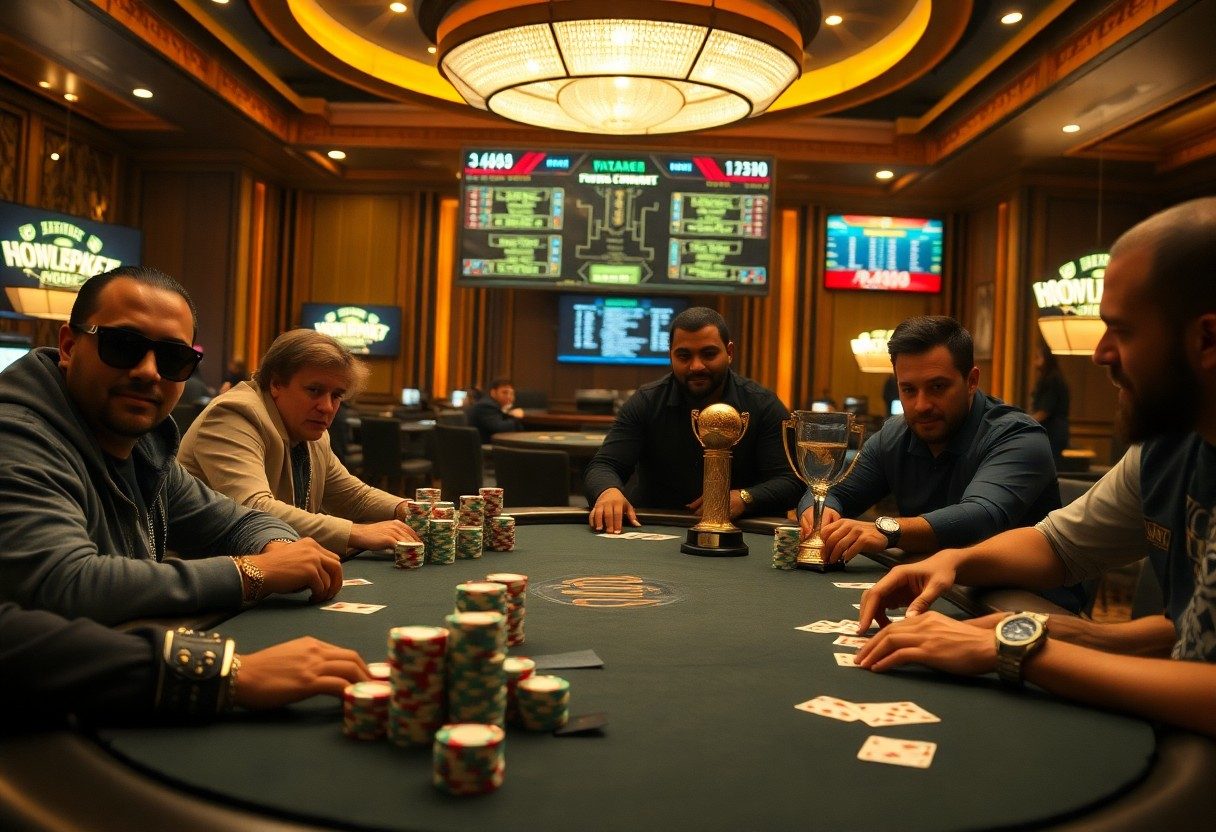
Most aspiring players can accelerate their development by studying today’s top pros: adopt disciplined bankroll management, sharpen hand-reading and exploitative aggression, commit to structured study routines, and guard against dangerous factors like variance and tilt, so you convert short-term swings into a durable edge.
Types of Successful Poker Pros
Top pros split into distinct archetypes: Cash Game Players who grind deep-stacked edges at $100/$200+ tables; Tournament Specialists who chase MTT titles and $50M+ career payouts; Mixed-Game Pros mastering Omaha/Stud variants; Online Specialists exploiting volume and HUD data; and Heads-Up Experts dominating one-on-one formats.
- Cash Game Players
- Tournament Specialists
- Mixed-Game Pros
- Online Specialists
- Heads-Up Experts
| Cash Game Players | Deep-stack skill, session endurance, examples: Phil Ivey, Patrik Antonius; stakes often $50/$100-$400/$800. |
| Tournament Specialists | ICM expertise, large-field navigation, examples: Justin Bonomo (~$57M live earnings), Bryn Kenney (~$56M). |
| Mixed-Game Pros | Switching formats (H.O.R.S.E., PLO8), lower variance, notable names: Chip Reese legacy; key skill: game selection. |
| Online Specialists | High-volume MTT grinders and cash sharks using HUDs; many play hundreds of events monthly and exploit multi-tabling. |
| Heads-Up Experts | Short-deck and HU NLH focus, aggressive ranges, example: Tom Dwan-era high-stakes heads-up; intense study on exploitative GTO deviations. |
Cash Game Players
Many cash pros build long-term edges by combining deep-stack math, strict bankroll management, and session discipline; high-stakes games often run at $100/$200+ with pots regularly exceeding $50k in televised matches, and players like Phil Ivey exemplify adaptability across live and online rings.
Tournament Specialists
Top tournament pros lean on ICM, endgame deal savvy, and field-reading; Justin Bonomo’s ~$57M in live earnings shows how sustained MTT success scales, while major events can draw thousands-WSOP fields frequently top 5,000 entrants for popular bracelet events.
Deeper study shows tournament specialists prioritize stage-specific adjustments: early phases require exploitative aggression to build stack, middle phases demand survival and pot control, and late stages hinge on ICM precision and short-stack mechanics; many play 200-1,000 online MTTs yearly for volume and still travel for 20-50 live events, balancing variance with targeted ROI. Any elite tournament pro treats table selection, final-table deal equity, and stamina as part of their competitive toolkit.
Key Tips from Top Players
Study how elite pros convert small edges: use HUDs to target tables where several players show VPIP >25% and PFR <10%, isolate limp-heavy opponents, and exploit predictable bet sizes; many winners also insist on a minimum of 20-50 buy-ins for cash and 100+ buy-ins for MTTs. Apply specific limits-track ROI, fold-to-3bet and aggression-frequency-and adjust seat choice aggressively. This emphasis on position, selective aggression, and disciplined bankroll management separates long-term winners.
- bankroll management
- table selection
- position
- aggression
- hand reading
- variance
Bankroll Management
Top players set concrete rules: keep at least 20 buy-ins for regular cash games and aim for 100-200 buy-ins for MTTs to survive variance; if bankroll drops below your threshold, move down immediately and treat a stop-loss-for example a 20% drawdown- as a signal to reassess. Track sessions with database software, compute your winrate (bb/100) and ROI, and size buy-ins so one buy-in is never more than ~5% of your total bankroll.
Table Selection
Prioritize tables with at least two obvious recreational players: look for VPIP >25% and low PFR numbers, frequent limp-ins, and high average pot sizes. Sit to the left of the weakest player to exploit positional advantages, and avoid high-rake games even if opponents look loose-small edges disappear fast when rake is heavy.
In practice, prefer full-ring when you want to exploit passive limpers (isolate with wider ranges) and 6-max when you can apply pressure; if two players limp ~30% and fold-to-3bet ~70%, widening your isolation range increases EV substantially. Use table-hopping early to sample the table for 20-30 hands, then commit; monitor time-of-day player pools and use HUD filters to find tables with a positive table price before sitting.
Step-by-Step Guide to Improving Your Game
| Step | Action |
|---|---|
| Bankroll & Limits | Maintain 20-50 buy-ins for cash, 100+ for MTTs; move up only after consistent ROI and positive BB/100. |
| Session Review | Review 300-1,000 hands/week with HUD, tag leaks, and run key spots through a solver. |
| Solver Work | Use PIOsolver or GTO+ on recurring river-turn lines; compare theoretical ranges to exploitative adjustments. |
| Table Selection | Prioritize tables with high average VPIP and low aggression among opponents; avoid stacked regs and high-IQ late-game fields. |
Analyzing Your Play
Export session databases, filter by position and stake, then focus on metrics like BB/100, WTSD, W$SD and fold-to-3bet; tag the top 20 recurring hands, replay them with a solver to identify specific leaks (range construction, bet sizing, or timing tells) and track improvement across 4-week blocks to quantify progress.
Developing a Study Routine
Block 45-90 minutes/day for focused study: 30-60 minutes of hand review and HUD analysis plus 15-30 minutes of solver or theory work, and schedule one 2-hour weekly deep dive with a coach or trusted study group.
Structure weekly cycles: Monday review last week’s worst 100 hands, Wednesday solver drills on two recurring spots, Friday group review and note SMART goals (specific, measurable, attainable, relevant, timed). Use tools like PT4/Hand2Note for queries, PIOsolver for ranges, and track metrics (ROI, std dev, BB/100) to verify that adjustments reduce variance and improve long-run EV; update the plan every 4 weeks based on measurable gains.
Factors Contributing to Success in Poker
- Mindset
- Bankroll Management
- Table Selection
- Game Theory
- Emotional Control
- Study Routine
- Mental Toughness
Mindset and Mental Toughness
Top pros allocate 2-3 hours daily to hand review, deploy GTO solvers, and monitor metrics like BB/100 or tournament ROI; surviving downswings of dozens of buy-ins demands structured variance plans, disciplined bankroll rules and targeted practice on leak fixes, so players convert analytical findings into consistent in-game adjustments that sustain long-term profitability.
Emotional Control
Tilt destroys edges fast, so elite players use explicit routines: preset stop-loss rules (often 5-15 buy-ins), take breaks every 45-60 minutes, and perform brief breathing resets between sessions to prevent one bad hand from cascading into larger mistakes and lost ROI.
Further measures include logging emotional triggers, practicing 10-minute mindfulness or HRV breathing before play, exercising several times weekly to lower baseline stress, and running a concise post-session checklist; combining journaling with numeric session reviews reveals recurring tilt patterns and stabilizes winrate across stakes.
Thou must enforce strict session limits, stop-loss rules and post-session reviews to protect bankroll and decision quality.
Pros and Cons of Different Poker Strategies
| Pros | Cons |
|---|---|
| Aggressive betting generates fold equity and wins many pots without showdown. | Creates higher variance and larger downswings versus sticky opponents. |
| Passive/tight play lowers variance and simplifies decision-making for bankroll control. | Easy to exploit by steals and yields a lower long-term winrate. |
| Loose-aggressive (LAG) attacks blinds frequently, producing high ROI against weak fields. | Requires advanced postflop skills and leads to big swings if misplayed. |
| Tight-aggressive (TAG) balances selectivity with aggression for consistent ROI. | Can become predictable to observant regs without adjustments. |
| GTO minimizes exploitable lines and performs well against other strong players. | Hard to implement without solvers; often suboptimal versus weak opponents. |
| Exploitative play maximizes gains from opponents’ mistakes and leak patterns. | Backfires when opponents adapt; demands accurate reads and tracking. |
| Short-stack shove/fold simplifies MTT late stages and caps downside risk. | Limits upside and becomes predictable for callers with medium stacks. |
| Multi-street bluffing can extract large pots and balance ranges when done selectively. | Fails often versus callers with high calling frequencies; needs precise sizing and planning. |
Aggressive vs. Passive Play
Top pros balance aggression: aiming for benchmark ranges like PFR 12-25% with VPIP matched to table dynamics. Aggression converts equity into immediate wins-continuation bets and 3-bets create pressure-while passive players who limp/call a high share cede fold equity and often see a lower ROI. Against weak fields, measured aggression (open-raise frequency 18-30%, 3-bet 5-8%) typically outperforms passivity; conversely, passive play reduces variance but surrenders long-term edge if opponents refuse to fold.
Bluffing Techniques
Successful bluffs hinge on math and image: use semi-bluffs with draws that have ~30-35% equity (flush draws ~35%, open-enders ~31.5%) and target situations where break-even fold frequency is achievable-e.g., betting 50 into 100 requires >33% fold rate. Employ blocker cards and position to improve success, and avoid bluffing players who call >60% of the time.
Deepening this, craft multi-street bluffs around range polarization and opponent tendencies: size larger on turns when the board favors your polarized river stories, and use blockers (an ace or two high cards) to reduce opponent combinations that beat your bluff. Combine solver-informed frequencies with exploitative shifts-if a villain folds to river bets 40% of the time, increase river bluff frequency accordingly. Maintain a mix of pure bluffs and semi-bluffs; linked examples from high-stakes cash games show pros converting ~25-40% of well-timed bluffs when using proper sizing and positional advantage, but mis-timed bluffs against sticky opponents can lose significant portion of stack equity, so always quantify fold equity before firing.
Common Mistakes and How to Avoid Them
Beginners habitually make avoidable errors-most notably overestimating hands and ignoring position. Winning pros open roughly 8-12% from early position and 18-30% from late, fold more to aggression, and exploit position to extract value; adjusting those ranges and folding marginal holdings after 3-bets often shifts win-rate by several BB/100. Adopt tighter early ranges and position-based aggression to stop leaking EV.
Overestimating Hands
Calling big bets with top pair and a weak kicker or chasing one-card straight draws is a common leak; when the pot offers 2:1 you need about 33% equity to call, so avoid calling shoves or large raises with hands that hold less than one-third equity. Against a 3-bet from a tight opponent, fold hands you would normally open-preserve equity and wait for better spots.
Ignoring Position
Playing marginal hands out of position turns small edges into losses: on the button you can profitably open about 25-30% of hands, while UTG should stick to 8-12%. Acting last lets you control pot size, realize bluffs more often, and use smaller bet sizes to extract value; prioritize hands that play well postflop when out of position.
Practical adjustments: widen button and cutoff ranges to ~25-30%, tighten UTG, c-bet in position around 45-60% but reduce to 20-35% OOP, and use larger 3-bet sizes when out of position (e.g., 3-4× open) to compensate for informational disadvantage.
Summing up
Following this, aspiring players should adopt disciplined bankroll management, rigorous study, emotional control, opponent-aware adjustments, and a relentless work ethic; by combining statistics-driven decision making with patience and integrity, they can accelerate progress and achieve consistent, sustainable success at modern poker tables.
FAQ
Q: What mindset and personal habits do today’s top poker professionals use that aspiring players should adopt?
A: Top professionals prioritize process over short-term outcomes: they set concrete goals for sessions (e.g., hands studied, specific spots reviewed) and evaluate performance by decisions made rather than results. They cultivate patience and emotional control, using routines to prevent tilt (breathing, short breaks, pre-session mental checks). Successful players are adaptable-they change tactics when opponents adjust, and they maintain curiosity, treating losses as information for improvement. They also schedule deliberate rest and off-table activities to preserve focus and avoid burnout.
Q: Which study methods and tools do successful pros rely on to improve their game efficiently?
A: Successful pros combine analytics and deliberate practice: they use solvers and equity tools to understand balanced ranges, tracking software to spot leaks in their own play, and hand history reviews (both solo and with peers or coaches) to test alternative lines. They run focused drills-e.g., defending blind ranges, turn/river decision trees-and simulate situations with training partners or software. They balance theory with applied practice by translating solver outputs into simplified heuristics that work at their stake level, and they keep a structured study plan with measurable milestones.
Q: How do professional players approach bankroll management, table selection, and long-term career planning?
A: They treat poker like a business: strict bankroll rules for each format, clear shot-taking criteria for moving up stakes, and conservative drop-down plans when variance hits. Table and game selection is strategic-choosing games with exploitable players, avoiding overly tough tables, and prioritizing soft edges over pure volume. Off-table, they manage finances (tax planning, savings), invest in coaching when it yields ROI, and build networks for staking or game flow. They also protect their edge by maintaining physical health, sleep, and mental resilience so they can make high-quality decisions consistently.